This year (and next) we expect one of the most predictable fruit pests we have - periodical cicada!
Periodical cicada will have major outbreaks in Virginia in 2020 and 2021. This pest complex is well known as emerging every 17 years. However there are several overlapping broods so that less than 17 years may elapse between appearances. Nevertheless, periodical cicada is a pest that seems to overwhelm the pest management program for short periods, at sporadic intervals.
I. The species: There are three species of seventeen-year cicadas [M. septendecim (L.), M. cassini (Fisher) and M. septendecula Alexander and Moore] and also three species of the more southerly ranging thirteen year cicadas (M. tredecim Walsh and Riley, M. tredecassini Alexander and Moore, and M. tredecula Alexander and Moore). There is some thought that there are only three species, each with a 17 and 13-year form.
There were originally 30 broods of periodical cicadas defined by Charles Marlatt, most separated geographically (Broods I-XVII are 17-year species; XVIII-XXX are 13-year species) (Charles Marlatt was an interesting individual who figured prominently in the development of our country's laws protecting against invasive species - I'll write more about him later). Not all broods are large enough to be horticulturally important, and some have gone extinct. There are now about 15 active broods. Brood X is the most important numerically and geographically; it last appeared in 2004; it will appear again in 2021. Brood IX is the brood that will appear in 2020 in southwest Virginia and adjacent North Carolina and Tennessee. A map of the yearly occurrence of the various broods in Virginia is given in a Virginia Tech factsheet. See an Adobe Presenter presentation (10 minutes) for periodical cicada in Virginia.
II. Hosts: The host range is very broad; almost any tree is attacked except for those that create sufficient gummy exudate to kill nymphs (e.g. pines). Apple is attacked very successfully. Stone fruits may be attacked, especially under heavy population pressure, but are less suitable hosts. Research in Pennsylvania has shown that if the wound is gummed, mortality of the egg mass can result. Gumming increases with the number of attacks per tree. Grapevines are readily attacked, but only young vines are considered to be at much risk.
III. Description: Adults have black bodies with red eyes and red-orange wings veins.


IV. Life history: Periodical cicada spends most of its life as a nymph, feeding on xylem sap from tree roots at a depth of 6-18 inches. In the final year of development, nymphs crawl from the soil, climbing tree trunks or any other structure. During the night, the nymphal skin splits along the midline, and the adult emerges. Thousands of adults and exuviae (shed skins) may be found with each tree in the orchard. The image below shows the shed skins in an apple orchard in Patrick County in 1986 - the grandparents of this year's brood! These reflect nymphs that developed on roots of that tree!

Adults appear in mid-late May (a few individuals may be heard as early as late April in Virginia). They appear around sunset, males slightly preceding females. Males form chorusing centers of great aggregations.
The characteristic sound made by males is produced by a membrane called a tymbal, present only in males; this membrane on the side of the first abdominal segment is backed by an air-filled resonating chamber. (note the white structure seen at the front end of the abdomen, just behind the wings in the image of the male above). Sound is made by vibrating the tymbal. The structure for hearing, the tympana (plural of tympanum, the same term used for our ear drum) are present in both sexes; these membranes are tucked beneath protective plates on the underside of the insect.

Singing peaks around 10:00 AM. Adults feed on a wide range of woody plants during the day; such feeding is apparently restricted to the females since the male digestive tract is rudimentary.
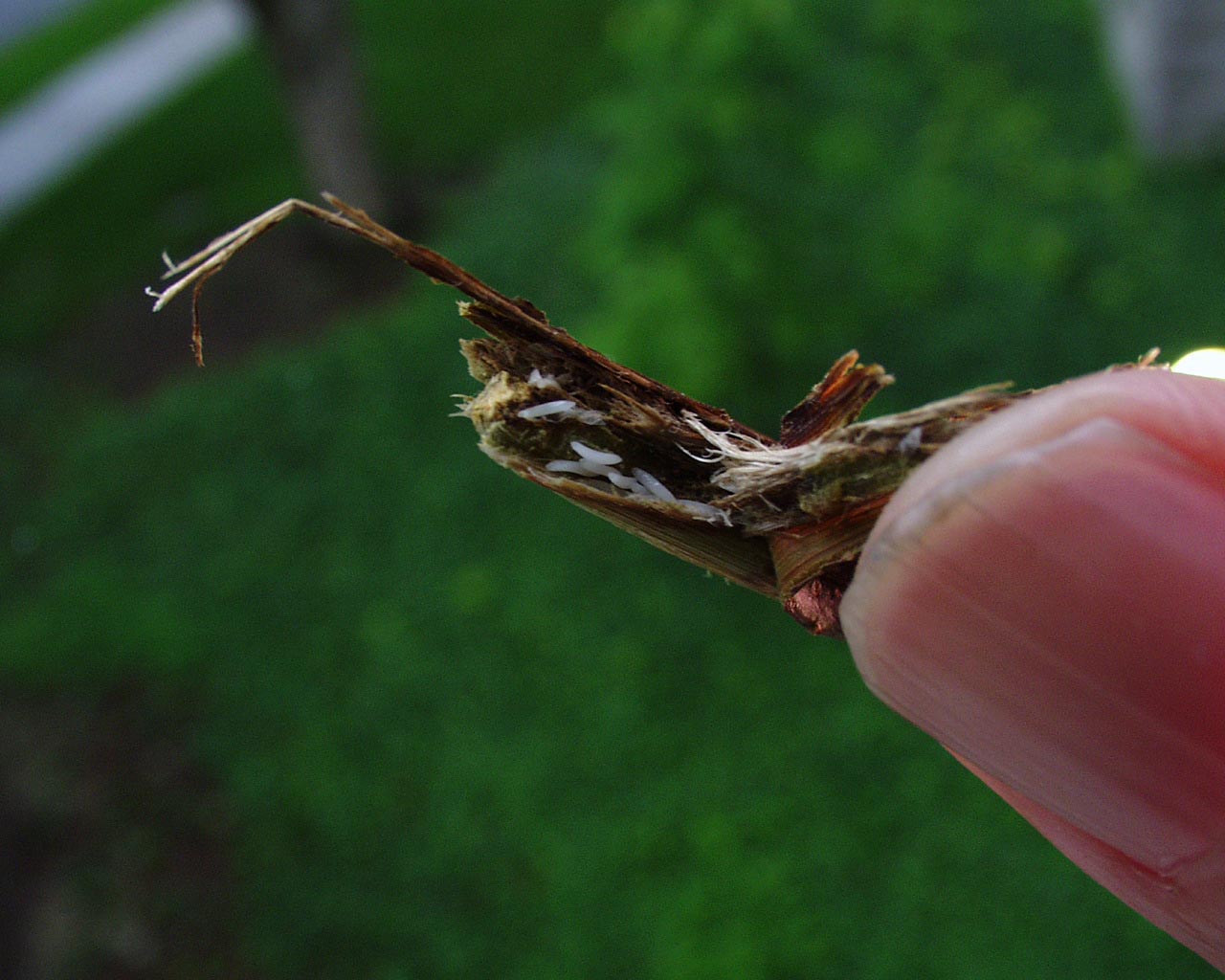
Oviposition begins about 2 weeks after emergence. Eggs are inserted into twigs in groups in groups of 10-25; the slit into which the eggs are inserted is 1-4 inches (2.5-10 cm) long. Females may lay over 500 eggs. Oviposition peaks in the early afternoon. (See YouTube oviposition clip).


Adults are active for about 6 weeks. Eggs hatch 6-10 weeks after oviposition, whereupon nymphs leave the twigs and drop to the soil. Nymphs tunnel to the roots where they establish themselves for feeding.
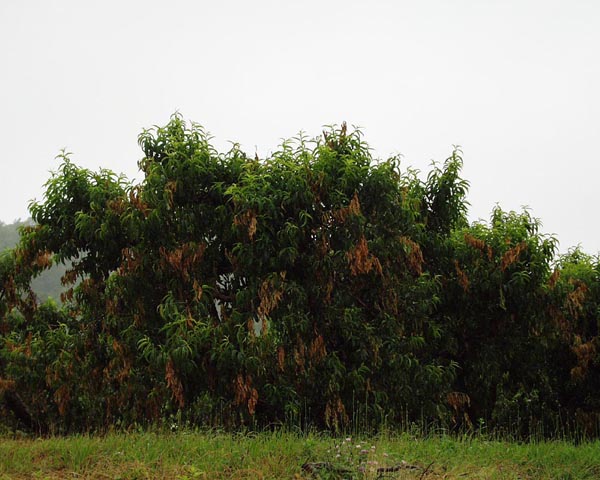
V. Injury: The main damage arises from oviposition wounds in twigs.


The region distal to the wound dies. This can be very damaging to the structure of the tree, especially in young blocks. There is greater limb breakage during the season on cicada-injured trees. It is worthwhile to delay planting a block if an emergence is expected within one or two years. A second avenue of injury is feeding by the nymphs. A New York study showed that if nymphs were kept from reaching the roots, growth of apple trees was enhanced. Adults may also feed through bark, causing oozing of sap; this is probably of minor importance. In pear, shoot injury from periodical cicada can provide entry to the fire blight pathogen.
Most injury in mature vineyards can be tolerated because most oviposition occurs distal to the clusters, and injured shoots will be pruned off later. However, young vines are subject to severe injury, with females using even the trunks as oviposition sites. Affected areas become weak and will break easily. Such young vineyards should be protected.
VI. Monitoring: During springs when adult emergence is expected, watch for the appearance of adults in the orchard. No thresholds are currently available. Treat when aggregations begin to appear in the orchard.
VII. Control: I'll touch on several tactics that may help in cicada management:
Cultural control: Modifying planting date can be helpful in limiting impact of periodical cicada. The females prefer to lay eggs in twigs or shoots that are about pencil diameter. Egg laying here has the greatest impact in young trees or vines. So it is a good idea not to plant new fruit trees or vines within a year or two of an expected emergence.
Mechanical control: Netting has been shown to be a cost effective tool to preventing injury to fruit trees. The netting would have to be in place for about 6 weeks of adult activity.
Chemical control: When using insecticides to control periodical cicada, it is important to use a contact insecticide that kills quickly enough to prevent oviposition. We have a few insecticides that are rated as excellent - the pyrethoids Asana and Danitol, plus the carbamate Lannate. We have Assail and Surround rated as good. (As always, check the label to make sure a product is registered on your fruit crop!) There is a problem in that some of the most effective materials are also toxic to beneficial species. It may be possible to avoid spraying a whole block by concentrating on areas of high density - chorusing centers. Scout the block at the outset to see if this might be possible.
Biological control: It is very difficult for predators and parasitoids to handle periodical cicadas. The likely evolutionary approach by these cicadas is to emerge synchronously in such high numbers so as to overwhelm the ability of natural enemies to respond. The most important natural enemies of periodical cicadas include parasitic wasps and flies and predatory mites attacking the eggs, and birds attacking the adults. Cicada killer wasps also attack later adults, but these wasps are timed mainly for the later emerging annual cicadas. A fungal disease, Massospora cicadina, infects the adults. However, these natural mortality agents are insufficient to provide control of the massive outbreaks typical of periodical cicada.
I hope this is helpful.
More later,
Doug P.