Fruit Insect News from Doug Pfeiffer (Fruit Entomologist at Virginia Tech - Blacksburg)
Friday, July 9, 2021
Update on spotted lanternfly - first adults
Hello, everyone,
We are at crucial stage of development for our population of spotted lanternfly, both in terms of range expansion and seasonal phenology. You may remember that at the end of last season, we had detected SLF at a commercial vineyard for the first time, in a vineyard north of Winchester (we had earlier detected it on a table grape planting in Winchester). This week we found fourth instar nymphs at two commercial vineyards southwest of Winchester. Dr. Johanna Elsensohn, a post doctoral researcher with USDA-ARS, found a single nymph on a vine. At both of these Frederick County vineyards we found nymphs on tree of heaven on both sides of the blocks – the vineyards are essentially surrounded!
Fig. 1-2. Spotted lanternfly fourth instar nymphs on tree of heaven surrounding a vineyard.
Yesterday, the first adults of SLF for this season were reported. This is an important time of the season, since the adult stage is the main dispersal stage. From now until fall, there will be a time of movement into vineyard blocks if SLF is established in the area. Growers in such areas should be watchful. Adults will form large feeding aggregations, and can impost a large drain on the vine.
Fig. 3-4. Spotted lanternfly fourth instar nymphs on tree of heaven surrounding a vineyard.
In both of these vineyards, there were stands of young tree of heaven that had grown from cut trees. It will be helpful to remove tree of heaven, but it is important to not simply cut the trees with out supplemental herbicide treatment, because of the way these trees regenerate. Figs. 2 and 3 show nymphs on such small trees (Figs. 1 and 4 contain nymphs on mature trees). We are fortunate in having only a single generation of SLF. If we start the season with a low population of young nymphs, it is unlikely that significant immigration will occur, and additional sprays may not be needed. This can change with the mobility of winged adults.
Fig. 5. Adult spotted lanternfly
This year is likely to be a year of additional commercial vineyards with populations of SLF. Apple and peach orchards may also see feeding aggregations, but these may be transient. Hops are also fed upon, but more information is needed on duration and severity, Please let me know of observations at your plantings.
More later,
Doug
Wednesday, June 30, 2021
Cicada aftermath, and bird/cicada controversy
Hello, everyone,
This year's emergence: This emergence of Brood X periodical cicada has now pretty much run its course – the adult stage anyway. If you have young fruit trees, it might be helpful to prune off damaged branches – this would prevent the nymphs from establishing on roots, helpful in the first formative years of the tree. Eggs normally hatch 6-10 weeks after oviposition. For us in Virginia, this was mainly a northern Virginia issue. Brood X extends up through eastern Pennsylvania and New Jersey (remember this when you get to the hot topic note toward the end!) There were also populations of Brood X south of Virginia (parts of North Carolina, Tennessee and Georgia). Here are the maps for Broods IX and X: Fig. 1. Maps of periodical cicada Broods IX and X, from Marlatt (1907)
The broods were characterized and named by the USDA entomologist Charles Marlatt in 1907 (Marlatt 1907). But while Marlatt made a great formal study of these insects and determined the geographical broods, he was not the first to determine the 17-year cycle. A free African-American naturalist, Benjamin Banneker, living in Maryland, born in 1731, reported this after an 1800 emergence (Barber and Nkwanta 2014). He successfully predicted subsequent emergences. Both of these individuals played other important roles – Banneker helped survey the borders of Washington DC, and Marlatt led the creation of the first regulations designed to protect us from invasive pests).
There are three Magicicada species that make up each brood of periodical cicada. The local species composition can very a lot, even within a county. Last week we sampled cicadas in Frederick County: at Fort Collier in Winchester, 94% were composed of M. cassini (34:2), while at Star Tannery in the southwestern part of the county, 76% were M. septendecim (16:5). M. cassini are smaller, with the underside of the abdomen completely black, compared with the larger M. septendecim, with red on each sclerite.
Fig. 2. Side-by-side comparison of Magicicada septendecim (top) and M. cassini (bottom).
While M. cassini may lay their eggs in smaller branches, I’ve seen no comparison of the economic impact of the species, and they are treated equivalently.
It was originally thought that most egg-laying occurred distal to the clusters of grapevines, and so on grape, injury was most important on young vines. Clearly some of the injury we saw was basal to clusters, and those clusters will be lost. While young vines are at particular risk, there is clear economic impact to bearing vines. At this point, it is not recommended to prune out affected shoots, but rather wait until winter pruning.
Fig. 3. Egg nests of periodical cicada may occur either above or below grape clusters.
Coming attractions: The adults of this emergence of Brood X are now a recent memory. As I’ve pointed out in extension presentations, it is wise to avoid planting a new orchard or vineyard a year or two before an anticipated emergence. However, we don’t usually give this warning long enough in advance for sufficient planning, given the lead time needed by nurseries, to get desired scion/rootstock combinations. Here is a listing in order of appearance of broods relevant to Virginia. The most important ones will likely be XIX, II, IX and X. Click on the Brood numbers to see a map.
Brood XIX (13 year): (Southside Virginia) The Great Southern Brood (2024)
Brood XIV: southern OH, KE, TN, MA, MD, NC, PA, northern GA, southwestern VA and WV, parts of NY and NJ (2025)
Brood I: The Blue Ridge Brood: Western VA, WV (2029)
Brood II: East Coast Brood: CT, MD, NC, NJ, NY, PA, DA, VA, DC. (2030)
Brood V: eastern OH, western MD, southwestern PA, northwestern VA, WV, NY (Suffolk Co.) (2033)
Brood IX: southwestern VA, southern WV, western NC (2037)
Brood X: The Great Eastern Brood: NY, NJ, PA, DE, MD, DC, VA, WV, NC, GA, TN, KE, OH, IN, IL, MI (2038)
Addressing a hot topic: Another issue has been broached in the news in the past few days that I would like to comment on. There has been a recent wave of unexplained bird deaths and illness in northern Virginia. Symptoms include blindness or crusty eyes, and neurological problems. The idea was postulated that eating cicadas was responsible for this bird morbidity/mortality. This is circumstantial at best. There were no such problems noted last year in Brood IX in southwest Virginia, nor in earlier emergences of Brood X in northern Virginia.
https://www.ecowatch.com/mystery-disease-killing-birds-2653532689.html
https://www.npr.org/2021/06/28/1011043752/correlation-not-causation-brood-x-cicadas-and-regional-bird-deaths?utm_source%C3%BAcebook&utm_medium%C3%BEws_tab&utm_content%C3%BFgorithm
Cicadas have long been considered a nontoxic food for birds (Leonard 1964, Steward et al. 1988, Williams and Simon 1995). Birds feeding on cicadas have included European starling, common grackles, American robin, wood thrush, blue jay, yellow-billed and black-billed cuckoos, red-winged blackbirds, house sparrow, redheaded woodpecker, tufted titmouse, vireos, terns, laughing gull and ducks. I birded last year with friends in areas of Brood IX adult periodical cicada activity, and we saw no unusual bird behavior (the worst thing was not being able to hear birds above the cicada singing!). Periodical cicadas present an important part of nutrient cycling in forests, and are a nutritional resources for predators (Wheeler et al. 1992).
There is an entomopathogenic fungus, Massospora, that may provide some natural mortality to periodical cicadas. There are compounds in Massospora that are psychoactive in cicadas, causing them to change their behavior (Boyce et al. 2019). One compound in Massospora, cathinone (Boyce et al. 2019), has been known to have psychoactive properties in humans (Langman and Jannetto 2020). But there is no record of eating Massospora-infected cicadas being harmful to birds. Moreover, Massospora is a natural component of the system, and unusual bird maladies are not reported following cicada emergences.
One interview (linked above) speculated whether birds might be picking up insecticides or heavy metals from sprayed cicadas. In an earlier study (Clark 1992), cicadas were not found to be a source of significant levels of organochlorine insecticides or heavy metals for birds. Organochlorines have been replaced by other classes of chemistry, but that group was longer lived, and would bioaccumulate. Modern insecticides should pose less of a hazard in this regard.
So in summary, here are my thoughts on cicada involvement with the bird death/sickness syndrome. If the situation changes, or new information becomes available I’ll let you know:
• There was no issue with bird mortality/morbidity with last year's brood IX, nor northern Virginia Brood X last time.
• Massospora has been a part of the landscape for a long time, with no apparent link to birds.
• There was no apparent bird problem in PA or NJ, nor Tennessee or North Carolina, where Brood X was abundant. Note: Some increasing bird mortality was seen in southern NJ after cicadas had disappeared, well after the outbreak in northern Virginia. This weakens the case for synchrony between cicadas and bird deaths.
• There have been changes in pesticides used over the years, but from last year in Brood IX, there wouldn't be any difference with this year in Brood X.
• If cicadas, fungus, or pesticides are involved, there must be some other environmental change to shift their importance.
Reporting Bird Mortality: The Department of Wildlife Resources has created a reporting form for cases of sick or dead birds:
https://dwr.virginia.gov/wildlife/diseases/bird-mortality-reporting-form/
More later,
Doug
References
Barber, J. E., and A. Nkwanta. 2014. Benjamin Banneker's original handwritten document: Observations and study of the cicada. Journal of Humanistic Mathematics 4: 112-122.
Boyce, G. R., E. Gluck-Thaler, J. C. Slot, J. E. Stajich, W. J. Davis, T. Y. James, J. R. Cooley, D. G. Panaccione, J. Eilenberg, H. H. De Fine Licht, A. M. Macias, M. C. Berger, K. L. Wickert, C. M. Stauder, E. J. Spahr, M. D. Maust, A. M. Metheny, C. Simon, G. Kritsky, K. T. Hodge, R. A. Humberi, GullionT., D. P. G. Short, T. Kijimoto, D. Mozgai, N. Arguedas, and M. T. Kassona. 2019. Psychoactive plant- and mushroom-associated alkaloids from two behavior modifying cicada pathogens. Fungal Ecol. 41: 147-164.
Clark, D. R. 1992. Organochlorines and heavy metals in 17-year cicadas pose no apparent dietary threat to birds. Environ. Monit. Assess. 20: 47–54.
Langman, L. J., and P. J. Jannetto. 2020. Toxicology and the clinical laboratory pp. 917-951. In W. Clarke and M. A. Marzinke (eds.), Contemporary Practice in Clinical Chemistry. 4th Ed. Elsevier.
Leonard, D. E. 1964. Biology and ecology of Magicicada septendecim (L.) (hemiptera: Cicadidae). J. New York Entomol. Soc. 72: 19-23.
Marlatt, C. L. 1907. The periodical cicada. U. S. Dept. Agric. Bur. Entomol. Bull. 71: 1-181. Steward, V. B., K. G. Smith, and F. M. Stephen. 1988. Red-winged blackbird predation on periodical cicadas (Cicadidae Magicicada spp.) - Bird behavior and cicada responses. Oecologia 76: 348-352.
Wheeler, G. L., K. S. Williams, and K. G. Smith. 1992. Role of periodical cicadas (Homoptera: Cicadidae: Magicicada) in forest nutrient cycles. Forest Ecol. Manag. 51: 339-346.
Williams, K. S., and C. Simon. 1995. The ecology, behavior, and evolution of periodical cicadas. Annu. Rev. Entomol. 40: 269-295.
This year's emergence: This emergence of Brood X periodical cicada has now pretty much run its course – the adult stage anyway. If you have young fruit trees, it might be helpful to prune off damaged branches – this would prevent the nymphs from establishing on roots, helpful in the first formative years of the tree. Eggs normally hatch 6-10 weeks after oviposition. For us in Virginia, this was mainly a northern Virginia issue. Brood X extends up through eastern Pennsylvania and New Jersey (remember this when you get to the hot topic note toward the end!) There were also populations of Brood X south of Virginia (parts of North Carolina, Tennessee and Georgia). Here are the maps for Broods IX and X: Fig. 1. Maps of periodical cicada Broods IX and X, from Marlatt (1907)
The broods were characterized and named by the USDA entomologist Charles Marlatt in 1907 (Marlatt 1907). But while Marlatt made a great formal study of these insects and determined the geographical broods, he was not the first to determine the 17-year cycle. A free African-American naturalist, Benjamin Banneker, living in Maryland, born in 1731, reported this after an 1800 emergence (Barber and Nkwanta 2014). He successfully predicted subsequent emergences. Both of these individuals played other important roles – Banneker helped survey the borders of Washington DC, and Marlatt led the creation of the first regulations designed to protect us from invasive pests).
There are three Magicicada species that make up each brood of periodical cicada. The local species composition can very a lot, even within a county. Last week we sampled cicadas in Frederick County: at Fort Collier in Winchester, 94% were composed of M. cassini (34:2), while at Star Tannery in the southwestern part of the county, 76% were M. septendecim (16:5). M. cassini are smaller, with the underside of the abdomen completely black, compared with the larger M. septendecim, with red on each sclerite.
Fig. 2. Side-by-side comparison of Magicicada septendecim (top) and M. cassini (bottom).
While M. cassini may lay their eggs in smaller branches, I’ve seen no comparison of the economic impact of the species, and they are treated equivalently.
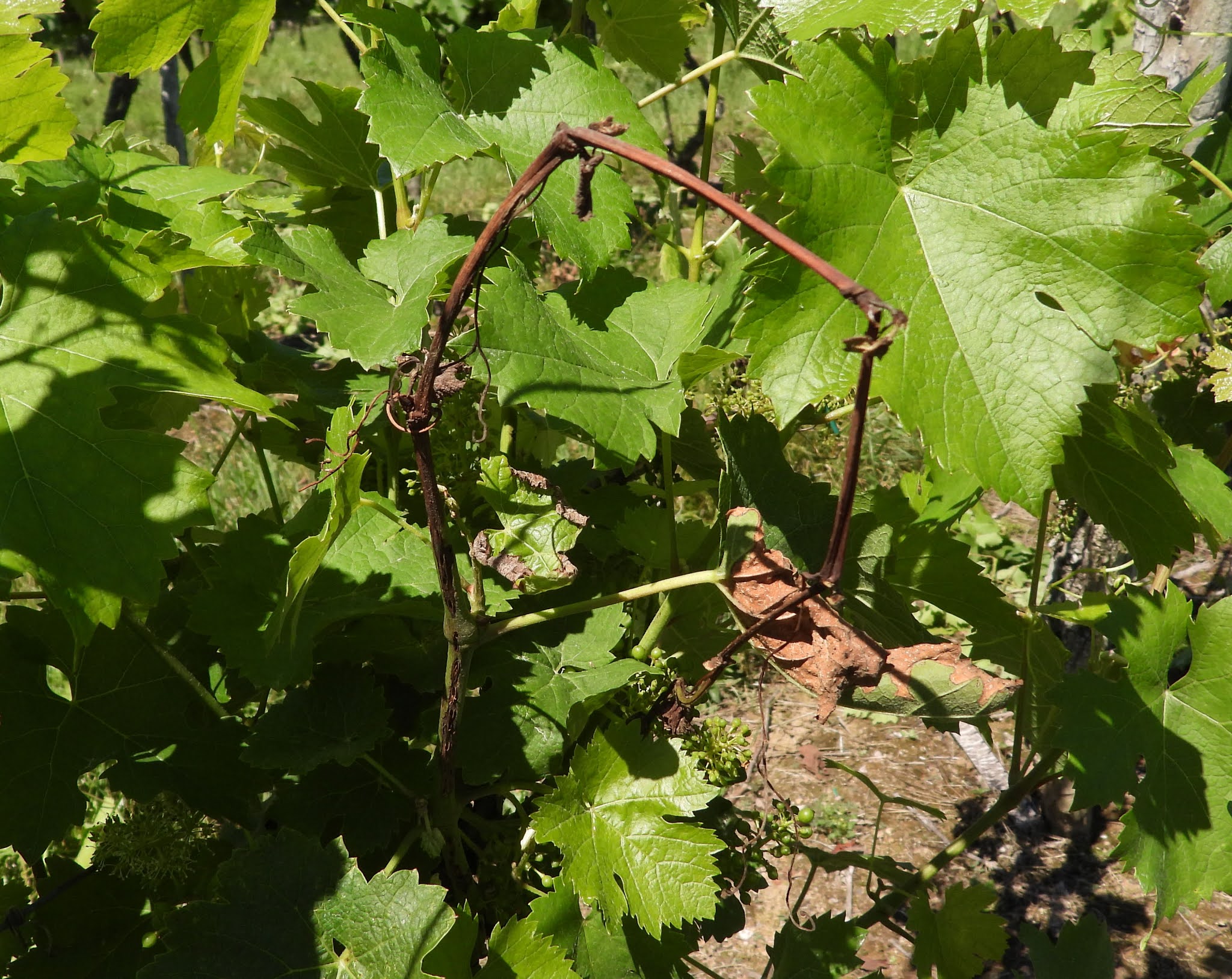
It was originally thought that most egg-laying occurred distal to the clusters of grapevines, and so on grape, injury was most important on young vines. Clearly some of the injury we saw was basal to clusters, and those clusters will be lost. While young vines are at particular risk, there is clear economic impact to bearing vines. At this point, it is not recommended to prune out affected shoots, but rather wait until winter pruning.
Fig. 3. Egg nests of periodical cicada may occur either above or below grape clusters.
Coming attractions: The adults of this emergence of Brood X are now a recent memory. As I’ve pointed out in extension presentations, it is wise to avoid planting a new orchard or vineyard a year or two before an anticipated emergence. However, we don’t usually give this warning long enough in advance for sufficient planning, given the lead time needed by nurseries, to get desired scion/rootstock combinations. Here is a listing in order of appearance of broods relevant to Virginia. The most important ones will likely be XIX, II, IX and X. Click on the Brood numbers to see a map.
Brood XIX (13 year): (Southside Virginia) The Great Southern Brood (2024)
Brood XIV: southern OH, KE, TN, MA, MD, NC, PA, northern GA, southwestern VA and WV, parts of NY and NJ (2025)
Brood I: The Blue Ridge Brood: Western VA, WV (2029)
Brood II: East Coast Brood: CT, MD, NC, NJ, NY, PA, DA, VA, DC. (2030)
Brood V: eastern OH, western MD, southwestern PA, northwestern VA, WV, NY (Suffolk Co.) (2033)
Brood IX: southwestern VA, southern WV, western NC (2037)
Brood X: The Great Eastern Brood: NY, NJ, PA, DE, MD, DC, VA, WV, NC, GA, TN, KE, OH, IN, IL, MI (2038)
Addressing a hot topic: Another issue has been broached in the news in the past few days that I would like to comment on. There has been a recent wave of unexplained bird deaths and illness in northern Virginia. Symptoms include blindness or crusty eyes, and neurological problems. The idea was postulated that eating cicadas was responsible for this bird morbidity/mortality. This is circumstantial at best. There were no such problems noted last year in Brood IX in southwest Virginia, nor in earlier emergences of Brood X in northern Virginia.
https://www.ecowatch.com/mystery-disease-killing-birds-2653532689.html
https://www.npr.org/2021/06/28/1011043752/correlation-not-causation-brood-x-cicadas-and-regional-bird-deaths?utm_source%C3%BAcebook&utm_medium%C3%BEws_tab&utm_content%C3%BFgorithm
Cicadas have long been considered a nontoxic food for birds (Leonard 1964, Steward et al. 1988, Williams and Simon 1995). Birds feeding on cicadas have included European starling, common grackles, American robin, wood thrush, blue jay, yellow-billed and black-billed cuckoos, red-winged blackbirds, house sparrow, redheaded woodpecker, tufted titmouse, vireos, terns, laughing gull and ducks. I birded last year with friends in areas of Brood IX adult periodical cicada activity, and we saw no unusual bird behavior (the worst thing was not being able to hear birds above the cicada singing!). Periodical cicadas present an important part of nutrient cycling in forests, and are a nutritional resources for predators (Wheeler et al. 1992).
There is an entomopathogenic fungus, Massospora, that may provide some natural mortality to periodical cicadas. There are compounds in Massospora that are psychoactive in cicadas, causing them to change their behavior (Boyce et al. 2019). One compound in Massospora, cathinone (Boyce et al. 2019), has been known to have psychoactive properties in humans (Langman and Jannetto 2020). But there is no record of eating Massospora-infected cicadas being harmful to birds. Moreover, Massospora is a natural component of the system, and unusual bird maladies are not reported following cicada emergences.
One interview (linked above) speculated whether birds might be picking up insecticides or heavy metals from sprayed cicadas. In an earlier study (Clark 1992), cicadas were not found to be a source of significant levels of organochlorine insecticides or heavy metals for birds. Organochlorines have been replaced by other classes of chemistry, but that group was longer lived, and would bioaccumulate. Modern insecticides should pose less of a hazard in this regard.
So in summary, here are my thoughts on cicada involvement with the bird death/sickness syndrome. If the situation changes, or new information becomes available I’ll let you know:
• There was no issue with bird mortality/morbidity with last year's brood IX, nor northern Virginia Brood X last time.
• Massospora has been a part of the landscape for a long time, with no apparent link to birds.
• There was no apparent bird problem in PA or NJ, nor Tennessee or North Carolina, where Brood X was abundant. Note: Some increasing bird mortality was seen in southern NJ after cicadas had disappeared, well after the outbreak in northern Virginia. This weakens the case for synchrony between cicadas and bird deaths.
• There have been changes in pesticides used over the years, but from last year in Brood IX, there wouldn't be any difference with this year in Brood X.
• If cicadas, fungus, or pesticides are involved, there must be some other environmental change to shift their importance.
Reporting Bird Mortality: The Department of Wildlife Resources has created a reporting form for cases of sick or dead birds:
https://dwr.virginia.gov/wildlife/diseases/bird-mortality-reporting-form/
More later,
Doug
References
Barber, J. E., and A. Nkwanta. 2014. Benjamin Banneker's original handwritten document: Observations and study of the cicada. Journal of Humanistic Mathematics 4: 112-122.
Boyce, G. R., E. Gluck-Thaler, J. C. Slot, J. E. Stajich, W. J. Davis, T. Y. James, J. R. Cooley, D. G. Panaccione, J. Eilenberg, H. H. De Fine Licht, A. M. Macias, M. C. Berger, K. L. Wickert, C. M. Stauder, E. J. Spahr, M. D. Maust, A. M. Metheny, C. Simon, G. Kritsky, K. T. Hodge, R. A. Humberi, GullionT., D. P. G. Short, T. Kijimoto, D. Mozgai, N. Arguedas, and M. T. Kassona. 2019. Psychoactive plant- and mushroom-associated alkaloids from two behavior modifying cicada pathogens. Fungal Ecol. 41: 147-164.
Clark, D. R. 1992. Organochlorines and heavy metals in 17-year cicadas pose no apparent dietary threat to birds. Environ. Monit. Assess. 20: 47–54.
Langman, L. J., and P. J. Jannetto. 2020. Toxicology and the clinical laboratory pp. 917-951. In W. Clarke and M. A. Marzinke (eds.), Contemporary Practice in Clinical Chemistry. 4th Ed. Elsevier.
Leonard, D. E. 1964. Biology and ecology of Magicicada septendecim (L.) (hemiptera: Cicadidae). J. New York Entomol. Soc. 72: 19-23.
Marlatt, C. L. 1907. The periodical cicada. U. S. Dept. Agric. Bur. Entomol. Bull. 71: 1-181. Steward, V. B., K. G. Smith, and F. M. Stephen. 1988. Red-winged blackbird predation on periodical cicadas (Cicadidae Magicicada spp.) - Bird behavior and cicada responses. Oecologia 76: 348-352.
Wheeler, G. L., K. S. Williams, and K. G. Smith. 1992. Role of periodical cicadas (Homoptera: Cicadidae: Magicicada) in forest nutrient cycles. Forest Ecol. Manag. 51: 339-346.
Williams, K. S., and C. Simon. 1995. The ecology, behavior, and evolution of periodical cicadas. Annu. Rev. Entomol. 40: 269-295.
Thursday, June 10, 2021
Periodical cicadas causing injury in vineyards and orchards
Hello, everyone,
Just a note on something many of you are aware of - periodical cicadas are now actively laying eggs in grapevines in northern Virginia vineyards. Mature vines have been attractive as well as young vines. Adults are normally active for about 6 weeks. The first report of adults emerging from soil was on April 28, but this was quickly followed by a period of cool temperatures, greatly slowing cicada development.
Just a few words on effective materials. Pyrethroids like Danitol and Baythroid are among the most effective materials. Assail, Sevin and Surround also have activity - some materials that are somewhat less effective have the benefit of less risk of inducing secondary pest outbreaks - especially mealybugs and mites. If you opt to use pyrethroids pay close attention to secondary pests for the subsequent weeks.
More later,
Doug
Thursday, May 20, 2021
Brood X of Periodical Cicada Active
Hello, everyone,
Periodical cicada does its most important injury by its oviposition behavior, using its ovipositor to make slits in shoots were eggs are deposited. The section of shoot or branch beyond this point dies, resulting in a brown flagging. Usually, this occurs beyond where fruit are growing, but this can vary and growers should be observant. The injury has its greatest impact on young fruit trees and grapevines, and these plants should be protected during periods of adult activity.
This year's appearance periodical cicada's Brood X has commenced. First appearance of emergence from the soil was seen on April 28 (thank you Adria Bordas for the notice!). Development was slowed by the period of cool weather we experienced. With warmer activity, adults are now becoming more active, and Mark Sutphin has noted this activity in Frederick County orchards.
For more details on periodical cicada, follow this link for a 20-minute recorded presentation:
https://www.virginiafruit.ento.vt.edu/PeriodicalCicada2020
There are 15 broods of periodical cicada (12 17-year forms, three 13-years forms in more southern areas). The details of distribution may change with changes in land use. Brood X (this year's brood) will be most intense in northern Virginia, north through eastern Pennsylvania and New Jersey. However, there are pockets in southwestern Virginia and North Carolina. If any of you note activity in southwestern counties, and in any counties around the edge of the range (see map), please le me know, so that we can update our records!
More later,
Doug
Spotted Lanternfly Update
Hello, everyone,
Spotted lanternfly is the newest invasive our fruit growers are having to deal with - fortunately, it is still limited in geographic range, but this range continues to expand.
First egg hatch this season was reported on April 28. Development was slowed by the period of cool weather we experienced, but more nymphs are now being seen.
SLF continues to expand its most intensive infestation in Frederick County, with several counties added. Clarke and Warren Counties now have scattered breeding populations, and individual finds have been made in Shenandoah,Page, Madison, Fauquier, Prince William, and Augusta Counties. The rankings for some of these sites may increase as further data are collected. It is important to note that there may not be breeding populations in some of the latter counties because of the ability of individual SLF to hitchhike.
The VDACS-designated quarantine zone has been expanded beyond Frederick County to include Clarke and Warren Counties.
Grape is the most vulnerable commercial crop. In October we discovered SLF at a commercial vineyard for the first time. However, the SLF range now surrounds some vineyards, so further detections in some of our northern vineyards are likely this season. SLF has also been detected at commercial orchards in Frederick County; impacts will be followed there as well.
Please let me know of detections you may make in your vineyards. In addition, you can report finds of SLF into the following portal:
https://ask2.extension.org/widget.html?team_id=1981?default_location=VA?default_county=All
In order to move regulated articles from the infestations zone, certification is needed. This certification is available at this location:
https://register.ext.vt.edu/search/publicCourseSearchDetails.do;jsessionid=E3FEE1B1C1921BA6848B382063FC0BDE?method=load&courseId=1066947
More later,
Doug
Thursday, February 18, 2021
2021 State Berry School Rescheduled
Hello, everyone,
Because of the inclement weather today, the state berry school I posted a few days ago, has been rescheduled. The new dates for the Virginia Berry School are Thursday, March 4th through Friday, March 5th. If you are registered already, you do not need to change anything, the link sent by VSU is still valid to log in. If you cannot attend on those days, the sessions will be available online after the event is over for viewing. If you know of anyone who still wants to register, we have reopened registration (https://www.ext.vsu.edu/events/2021/02/18/berry-school). If you need a refund because you no longer wish to attend, please contact Jessica Harris (jharris@vsu.edu) and you will receive a full refund. We hope to see you there!
Doug P.
Friday, February 12, 2021
Southeastern Strawberry School Webinar Series
Hello, everyone,
The Southern Region Small Fruit Consortium, in which Virginia Tech is a member, has organized the Southeastern Strawberry School Webinar Series. These webinars will take place throughout 2021. This series is hosted by the University of Arkansas in collaboration with university specialists from across the southeastern region. This webinar series is sponsored by the Southern Region Small Fruit Consortium and is open *free* to county agents, and growers. Follow this link for more details, and information on how to sign up.
Doug P.
Subscribe to:
Posts (Atom)
Grape Root Borer Mating Disruption for 2026
Hello, everyone, We have received word that our application for a Section 18 label for Isomate GRB Z has been approved. This is a mating ...
Indicia statement
Virginia Cooperative Extension programs and employment are open to all, regardless of age, color, disability, gender, gender identity, gender expression, national origin, political affiliation, race, religion, sexual orientation, genetic information, veteran status, or any other basis protected by law. An equal opportunity/affirmative action employer. Issued in furtherance of Cooperative Extension work, Virginia Polytechnic Institute and State University, Virginia State University, and the U.S. Department of Agriculture cooperating. Edwin J. Jones, Director, Virginia Cooperative Extension, Virginia Tech, Blacksburg; M. Ray McKinnie, Administrator, 1890 Extension Program, Virginia State University, Petersburg.