Hello, everyone,
We have received word that our application for a Section 18 label for Isomate GRB Z has been approved. This is a mating disruption product for grape root borer. We had a similar product available for several years that very successfully managed this destructive pest, but was lost for technical regulatory issues a couple of years ago, during the transition to a slightly modified product. Last year we had a Section 18 (Emergency Use) label for several states, including Virginia. These labels are in effect for just one year at a time, and there was no assurance that we would have this tool again for 2026. So this is good news - this approach is the most effective management tool for grape root borer.
I'm attaching here a copy of the 2026 label.
Please let me know if you have any questions.
Doug P.
Fruit Insect News from Doug Pfeiffer (Fruit Entomologist at Virginia Tech - Blacksburg)
Wednesday, May 6, 2026
Monday, November 3, 2025
Hello everyone,
As spotted lanternfly has continued its spread, some vineyards are showing low populations for the first time, while others are dealing with high populations for more that one year. The adults are the most damaging life stage for vineyards; thankfully populations will be brought to a stop by cold weather soon. Some areas have experienced some frosts by now, but this is not likely to have been severe enough to have really killed most adults.
If populations are high, control of adults should continue post harvest. Nutrients removed from the vines at this time will continue to negatively affect vine health. While Brigade has a long preharvest interval, it does have a 2ee label for postharvest use on grapes and hops - it is included in the table posted of effective spotted lanternfly materials (https://www.virginiafruit.ento.vt.edu/SLF_Insecticides.pdf).
Eggs are currently being laid to allow for overwintering. While the legal requirement of the quarantine program is no longer in effect, it is prudent to expect vehicles or other articles before movement beyond the infestation zone (https://www.ento.vt.edu/4-H_Entomology/SpottedLanternfly.html).
More later,
Doug P.
Wednesday, June 25, 2025
Details of use of grape root borer mating disruption
Hello, everyone,
A question was asked about dates of availability for the Section 18 label for Isomate GRB-Z. I wrote earlier that mating disruption is back for this species. A little more detail is needed. A Section 18 label (an emergency registration) is valid only for the current season. It will have to be requested again each year until a full, Section 3, label is in place.
In fact, the label lists specific, more restrictive dates. Effective dates of use are June 1 - July 30, with unused material (unopened containers) to be returned to the distributor by September 30.
I expect that a request for a new Section 18 label will be made for next season, if a full label has not yet been approved. But in the meantime, we must abide by the label restrictions.
More later,
Doug
Wednesday, June 18, 2025
Grape curculio and "flying ticks"
Hello, everyone,
Recently I've received questions about a weevil that looks suspiciously like grape curculio. First, a few words about the grape pest. Grape curculio is a reddish brown to black weevil which overwinters in the ground cover and leaf litter. Adults become active about the time of grape bloom. Adults feed on leaf tissue for about 2 weeks, and then females cut holes in young berries and insert an egg. Larvae are pale, legless, with a brown head capsule. The larvae feed within berries for about 3 weeks. When ready to pupate, larvae drop to the soil. The pupal stage lasts 3-4 weeks. Emerged adults feed on foliage until overwintering.
The insect in question now, the cause of questions, is superficially similar - almost black in color, between 2-3 mm in length, with an almost round outline in dorsal view. This species, however, is the yellow poplar weevil, also know as tulip poplar weevil, or sassafras weevil. Adults of this species also emerge from leaf litter in the spring, and mate during May to early June. Eggs are inserted into the midribs of yellow poplar (tulip poplar), sassafras and magnolia - all common plants in our area. The larvae are leafminers, and the pupal stage in passed within mines. Adults emerge in mid to late June. These new adultos are active for much of the season before entering overwintering quarters.
As I mentioned these are superficially similar in appearance. The adults of yellow poplar weevil are marked by striations or grooves on the elytra (wing covers). The prothorax - the section between the head and wings - is relatively small. Becuase of its size and round shape, the species is sometimes and incorrectly called "flying ticks" by the public. Weevils are entirely plant feeding! Two views of yellow poplar weevil follow:
In contrast, the dorsal surface of grape curculio is marked by several broad bumps, giving a more robust appearance. The prothorax is larger, relative to that of the yellow poplar weevil. These differene are best viewed with some good magnification.
The yellow poplar weevils, though numerous at times, are of no concern in the vineyard.
More later,
Doug
Tuesday, June 17, 2025
Grape Root Borer Mating Disruption is Back
Hello, everyone,
Grape root borer is a clearwing moth native to the southeastern US, the larvae of which feed on grape roots, each larva feeding for two years. Adults appear in late June, and resemble paper wasps. This pest can be extrememly destructive, making blocks unproductive, often killing vines. More information on GRB is posted here.
As many of you know, mating disruption has been the most effective management tool for grape root borer since it first received and EPA label in 2011. The commercial product, Isomate GRB, became unavailable for the 2024 season. When it became apparent that a replacement label would not be available for an extended time, we worked on an effort to apply for a Section 18 emergency registration. Thanks to combined efforts of many, the label was approved in time for the 2025 season.
I am creating links relating to the new product, Isomate GRB Z, here to the approved Section 18 Label for Virginia, a press release, and a press release, and a fact sheet.
More later.
Doug P.
Wednesday, February 12, 2025
2025 Fruit Pest Management Recommendations Posted
Hello, everyone,
This year's revisions to our fruit pest management guides are now available.
The guides are available for free in PDF form. Hard copies may be purchased.
2025 Spray Bulletin for Commercial Tree Fruit Growers Click here for PDF.
2025 Pest Management Guides
2025 Commercial Horticultural and Forest Crops (including Commercial Small Fruit, Commercial Vineyards, Commercial Hops) Click here for pdf.
2025 Home Grounds and Animals (including HomeFruit). Click here for pdf.
2024 Field Crops Click here for pdf.
More later,
Doug
This year's revisions to our fruit pest management guides are now available.
The guides are available for free in PDF form. Hard copies may be purchased.
2025 Spray Bulletin for Commercial Tree Fruit Growers Click here for PDF.
2025 Pest Management Guides
2025 Commercial Horticultural and Forest Crops (including Commercial Small Fruit, Commercial Vineyards, Commercial Hops) Click here for pdf.
2025 Home Grounds and Animals (including HomeFruit). Click here for pdf.
2024 Field Crops Click here for pdf.
More later,
Doug
Tuesday, February 4, 2025
2025 Orchard Fruit Schools
Hello, everyone,
Next week, we will be holding our annual orchard fruit schools, Monday through Thursday. Details are provided below:
Mon, Feb 10, 8:30 AM - The Winchester Fruit School, Alson H. Smith AREC, Winchester (contact Mark Sutphin, mark.sutphin@vt.edu). Tues, Feb 11, 8:30 AM - The Rappahannock-Madison Fruit School, Graves Mountain Lodge, Syria (contact Kenner Love, klove@vt.edu). Wed, Feb 12, 8:30 AM - The Nelson-Albemarle (Central Virginia) Fruit School, Nelson Center, 8445 Thomas Nelson Highway, Lovingston (contact Kim Bryant, kimeb5990@vt.edu). Thur, Feb 13, 8:15 AM - Carroll-Patrick Fruit School, Lambsburg Community Center, Lambsburg (contact Ashley Edwards, aledwards@vt.edu).
Topics will include reflections on 7 years of horticulture research, emerging insect issues, fire blight management, management of scale insects, legal and spray guide updates, and other topics.
See you at one of the schools!
Doug
Next week, we will be holding our annual orchard fruit schools, Monday through Thursday. Details are provided below:
Mon, Feb 10, 8:30 AM - The Winchester Fruit School, Alson H. Smith AREC, Winchester (contact Mark Sutphin, mark.sutphin@vt.edu). Tues, Feb 11, 8:30 AM - The Rappahannock-Madison Fruit School, Graves Mountain Lodge, Syria (contact Kenner Love, klove@vt.edu). Wed, Feb 12, 8:30 AM - The Nelson-Albemarle (Central Virginia) Fruit School, Nelson Center, 8445 Thomas Nelson Highway, Lovingston (contact Kim Bryant, kimeb5990@vt.edu). Thur, Feb 13, 8:15 AM - Carroll-Patrick Fruit School, Lambsburg Community Center, Lambsburg (contact Ashley Edwards, aledwards@vt.edu).
Topics will include reflections on 7 years of horticulture research, emerging insect issues, fire blight management, management of scale insects, legal and spray guide updates, and other topics.
See you at one of the schools!
Doug
Wednesday, July 17, 2024
Spotted lanternfly adult activity update
Hello, everyone,
Spotted lanternfly (SLF) development is about 2 weeks earlier than last year. INn 2023, first adults were seen on July 12, and in the grape-growing region of northern Virginia in 2024, June 29 (actually earlier farther east, June 12 in Richmond). Some vineyard high populations of fourth instars on Ailanthus trunks surrounding the vineyard. As adults appear in numbers, there will be immigration into vineyard blocks. There is a provisional action threshold of 5-10 adults given in the Pest Management Guide. This is likely to be conservative; unfortunately a multi-state proposal to provide a research-based action threshold was not funded this year.
A question has been asked of the advisability of removing tree of heaven (TOH) to help manage SLF. SLF is able to complete development in the absence of TOH, but does much better in its presence. It may be helpful to eliminate TOH from vineyard surroundings. However, in areas where SLF has been developing on TOH, this may not be the best time to remove those hosts, since it may hasten the movement of adult SLF into vineyard blocks.
Please let me know of any SLF-related questions.
Doug
Please let me know of any SLF-related questions.
Doug
Tuesday, February 6, 2024
2024 Fruit Pest Management Recommendations Posterd
Hello, everyone,
This year's revisions to our fruit pest management guides are now available.
The guides are available for free in PDF form. Hard copies may be purchased.
2024 Spray Bulletin for Commercial Tree Fruit Growers Click here for PDF.
2024 Pest Management Guides
2024 Commercial Horticultural and Forest Crops (including Commercial Small Fruit, Commercial Vineyards, Commercial Hops) Click here for pdf.
2024 Home Grounds and Animals (including HomeFruit). Click here for pdf.
2024 Field Crops Click here for pdf.
More later,
Doug
This year's revisions to our fruit pest management guides are now available.
The guides are available for free in PDF form. Hard copies may be purchased.
2024 Spray Bulletin for Commercial Tree Fruit Growers Click here for PDF.
2024 Pest Management Guides
2024 Commercial Horticultural and Forest Crops (including Commercial Small Fruit, Commercial Vineyards, Commercial Hops) Click here for pdf.
2024 Home Grounds and Animals (including HomeFruit). Click here for pdf.
2024 Field Crops Click here for pdf.
More later,
Doug
2024 Orchard Fruit Schools
Hello, everyone,
2024 Tree Fruit Schools
This year's orchard fruit schools will be held the week of Feb 12-15. Please note there is a different arrangement of dates from the past. There is no fruit school scheduled this year for Botetourt-Roanoke. Details are provided below:
Mon, Feb 12, 8:30 AM - The Winchester Regional Fruit School, Alson H. Smith AREC, Winchester (contact Mark Sutphin, mark.sutphin@vt.edu). Click here for agenda.
Tues, Feb 13, 8:30 AM - The Rappahannock-Madison Fruit School, Graves Mt Lodge, Syria (contact Kenner Love, klove@vt.edu). Click here for agenda.
Wed, Feb 14, 8:30 AM - The Nelson-Albemarle (Central Virginia) Fruit School, Lovingston Fire Hall, Lovingston (contact Grace Monger, gimonger@vt.edu). Click here for agenda.
Thur, Feb 15, 8:15 AM - Carroll-Patrick Fruit School, Lambsburg Community Center, Lambsburg (contact Ashley Edwards, aledwards@vt.edu). Click here for agenda.
I hope to see you at the fruit schools!
Doug
Mon, Feb 12, 8:30 AM - The Winchester Regional Fruit School, Alson H. Smith AREC, Winchester (contact Mark Sutphin, mark.sutphin@vt.edu). Click here for agenda.
Tues, Feb 13, 8:30 AM - The Rappahannock-Madison Fruit School, Graves Mt Lodge, Syria (contact Kenner Love, klove@vt.edu). Click here for agenda.
Wed, Feb 14, 8:30 AM - The Nelson-Albemarle (Central Virginia) Fruit School, Lovingston Fire Hall, Lovingston (contact Grace Monger, gimonger@vt.edu). Click here for agenda.
Thur, Feb 15, 8:15 AM - Carroll-Patrick Fruit School, Lambsburg Community Center, Lambsburg (contact Ashley Edwards, aledwards@vt.edu). Click here for agenda.
I hope to see you at the fruit schools!
Doug
Monday, January 22, 2024
A Double Brood of Periodical Cicadas in 2024?
Hello, everyone,
There has been discussion in the news and in social media this week of two broods of periodical cicada this year. Is this true, and how does that work? The answer to the first question is a qualified yes, but first I’ll give some background.
Cicadas are sucking insects that feed on xylem sap of various tree species. Annual cicadas emerge every year (though taking more than one year to develop feeding on tree roots). Periodical cicadas have a synchronized development, feeding on roots for 17 years (usually). A few broods have a 13-year cycle, mainly in more southern areas. When adults emerge, they do so in staggering numbers. They make remarkable “chorusing centers”, where males make a shrill singing sound, attracting both males and females. After mating, females use their sharp ovipositors to insert eggs into twigs of about pencil diameter. This is the source of economic injury – the area beyond the oviposition scar dies, creating a brown flagging of twigs. This is extremely damaging in a young orchard or vineyard.
There are about 12 17-year broods, and 3 13-year broods. These have different, but often overlapping geographical ranges. Some of these are widely spread, others sharply limited. The following map from the Forest Service, shows the distribution of periodical cicada broods, color coded. Because each county is assigned to only one brood, the degree of overlap of broods is sometimes vague, but there is some idea given of the range. Brood X is the most important to fruit producers in the mid-Atlantic region, but its range is somewhat obscured by coloration for other broods.
Fig. 1. Range of periodical cicada broods provided by US Forest Service. Brood XIII (the Northern Illinois Brood (17-year) is in brown; Brood XIX (the Great Southern Brood (13—year) is in light blue.
The first person known to have figured out the 17-year cycle of periodical cicada was Benjamin Banneker, a free African American living in Maryland. After observing outbreaks on his land in 1749, 1766 and 1783, he predicted an outbreak in 1800 (McGreevy 2021). That reference refers to Banneker working with Brood X of periodical cicada. He would not have known that term, because the recognition of the different geographical broods in different years, and the codifying these with Roman numerals was made by Charles Marlatt (Marlatt 1907), chief entomologist at USDA, and who also began some of the first regulations protecting the US from invasive pests.
In 2024, we can expect emergence of Brood XIX in Virginia (light blue in Fig. 1). But while Broods IX and X are the major broods affecting Virginia’s fruit production, the range of Brood XIX is limited here. It is nicknamed the Great Southern Brood because of the broad swath through the Deep South. But Virginia it is limited mainly to Southside (Hanover, Charles City, Prince George, Brunswick, Halifax and Wise Counties). In our Commercial Spray Bulletin for Commercial Tree Fruit Growers (VCE 2023), we have a map of expected emergence years of adult periodical cicadas, by county, for Virginia and West Virginia (see map). That map uses circles to indicate 13-year broods; all others are years for 17-year emergence.
Fig. 2. Periodical cicada map from VCE Publ. 456-419. Brood XIX denoted by encircled 24 counties.
Now for the explanation of the “qualified yes” regarding the double emergence of cicadas – emergence of more than one brood at a time. This can only happen rarely, when 17 year and 13 year cycles eventually meet in time. This year, 2024, we expect emergence of the 17-year XIII and the 13-year XIX. However, Brood XIII is nicknamed the Northern Illinois Brood for a reason (see Fig. 1). It will occur nowhere near Virginia! So this year, Virginians in Southside (and perhaps extreme southwestern Virginia) can expect to see periodical cicadas. Ecologically, this dual occurrence poses an interesting possibility – the chance for genetic exchange between broods that see each other only every few hundred years!
References
Marlatt, C. L. 1907. The periodical cicada. U. S. Dept. Agric. Bur. Entomol. Bull. 71: 1-181.
McGreevy, N. 2021. Meet Benjamin Banneker, the Black scientist who documented Brood X cicadas in the late 1700s, Smithsonian Magazine. (https://www.smithsonianmag.com/smart-news/meet-benjamin-banneker-black-scientist-who-documented-brood-x-cicadas-late-1700s-180977676/)
VCE. 2023. 2023 Spray Bulletin for Commercial Tree Fruit Growers. Va. Coop. Ext. Publ. 456-419. 180 p.
There has been discussion in the news and in social media this week of two broods of periodical cicada this year. Is this true, and how does that work? The answer to the first question is a qualified yes, but first I’ll give some background.
Cicadas are sucking insects that feed on xylem sap of various tree species. Annual cicadas emerge every year (though taking more than one year to develop feeding on tree roots). Periodical cicadas have a synchronized development, feeding on roots for 17 years (usually). A few broods have a 13-year cycle, mainly in more southern areas. When adults emerge, they do so in staggering numbers. They make remarkable “chorusing centers”, where males make a shrill singing sound, attracting both males and females. After mating, females use their sharp ovipositors to insert eggs into twigs of about pencil diameter. This is the source of economic injury – the area beyond the oviposition scar dies, creating a brown flagging of twigs. This is extremely damaging in a young orchard or vineyard.
There are about 12 17-year broods, and 3 13-year broods. These have different, but often overlapping geographical ranges. Some of these are widely spread, others sharply limited. The following map from the Forest Service, shows the distribution of periodical cicada broods, color coded. Because each county is assigned to only one brood, the degree of overlap of broods is sometimes vague, but there is some idea given of the range. Brood X is the most important to fruit producers in the mid-Atlantic region, but its range is somewhat obscured by coloration for other broods.
Fig. 1. Range of periodical cicada broods provided by US Forest Service. Brood XIII (the Northern Illinois Brood (17-year) is in brown; Brood XIX (the Great Southern Brood (13—year) is in light blue.
The first person known to have figured out the 17-year cycle of periodical cicada was Benjamin Banneker, a free African American living in Maryland. After observing outbreaks on his land in 1749, 1766 and 1783, he predicted an outbreak in 1800 (McGreevy 2021). That reference refers to Banneker working with Brood X of periodical cicada. He would not have known that term, because the recognition of the different geographical broods in different years, and the codifying these with Roman numerals was made by Charles Marlatt (Marlatt 1907), chief entomologist at USDA, and who also began some of the first regulations protecting the US from invasive pests.
In 2024, we can expect emergence of Brood XIX in Virginia (light blue in Fig. 1). But while Broods IX and X are the major broods affecting Virginia’s fruit production, the range of Brood XIX is limited here. It is nicknamed the Great Southern Brood because of the broad swath through the Deep South. But Virginia it is limited mainly to Southside (Hanover, Charles City, Prince George, Brunswick, Halifax and Wise Counties). In our Commercial Spray Bulletin for Commercial Tree Fruit Growers (VCE 2023), we have a map of expected emergence years of adult periodical cicadas, by county, for Virginia and West Virginia (see map). That map uses circles to indicate 13-year broods; all others are years for 17-year emergence.
Fig. 2. Periodical cicada map from VCE Publ. 456-419. Brood XIX denoted by encircled 24 counties.
Now for the explanation of the “qualified yes” regarding the double emergence of cicadas – emergence of more than one brood at a time. This can only happen rarely, when 17 year and 13 year cycles eventually meet in time. This year, 2024, we expect emergence of the 17-year XIII and the 13-year XIX. However, Brood XIII is nicknamed the Northern Illinois Brood for a reason (see Fig. 1). It will occur nowhere near Virginia! So this year, Virginians in Southside (and perhaps extreme southwestern Virginia) can expect to see periodical cicadas. Ecologically, this dual occurrence poses an interesting possibility – the chance for genetic exchange between broods that see each other only every few hundred years!
References
Marlatt, C. L. 1907. The periodical cicada. U. S. Dept. Agric. Bur. Entomol. Bull. 71: 1-181.
McGreevy, N. 2021. Meet Benjamin Banneker, the Black scientist who documented Brood X cicadas in the late 1700s, Smithsonian Magazine. (https://www.smithsonianmag.com/smart-news/meet-benjamin-banneker-black-scientist-who-documented-brood-x-cicadas-late-1700s-180977676/)
VCE. 2023. 2023 Spray Bulletin for Commercial Tree Fruit Growers. Va. Coop. Ext. Publ. 456-419. 180 p.
Sunday, July 23, 2023
Appearance of Spotted Lanternfly Adults
Hello, everyone,
This week, spotted lanternfly (SLF) adults began their appearance. There was an appearance of an adult in a vineyard in Bedford County on July 19. There is a possible appearance a day or so earlier that is being follow up on.
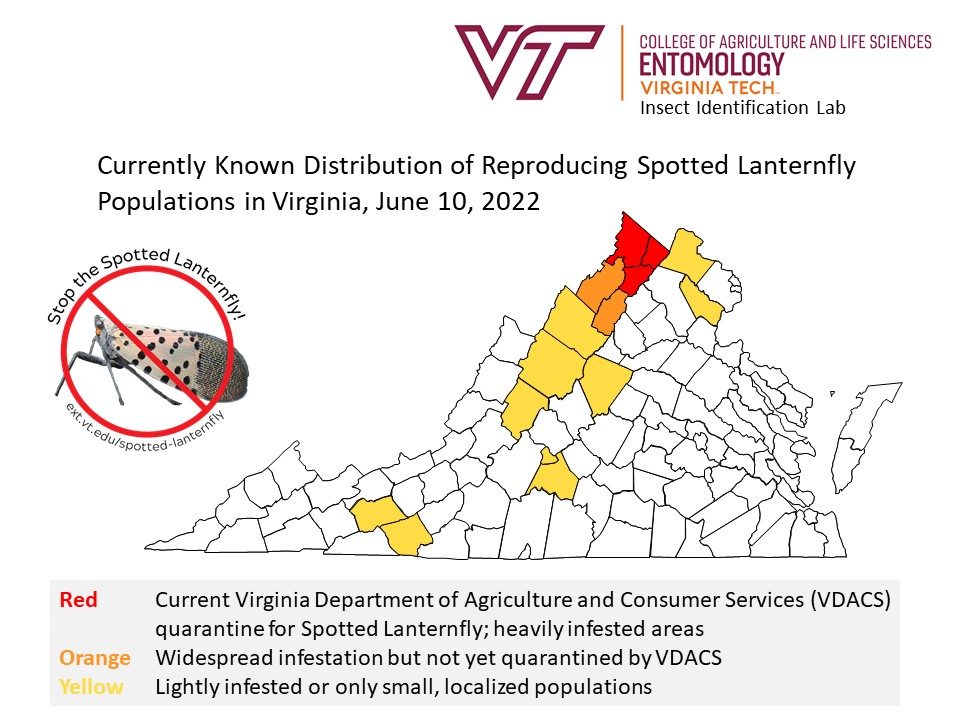
This map includes the most recent updates in geographic spread of SLF in Virginia, generated in the Insect Identification Lab in the Department of Entomology. Red counties are included in the VDACS quarantine; counties in orange have established populations but are not yet in quarantine.
The adult stage poses the greatest risk of immigration into vineyards, because of its mobility and attraction to grapevines. If adults are just showing up in an area, there is no need to overreact. In areas where SLF has been present in an area for a season or two, the pest pressure is likely to be higher. In the coming weeks, play close attention, looking for adults on cordons and canes. A provisional action threshold in vineyards is 5-10 adults per vine. I emphasize the term provisional. This may go up or down as we gain further experience with this insect in our vineyards. There is often a strong edge effect with this insect, and border sprays may be able to handle the problem, without spraying the whole block.
The Pest Management Guide chapters for Commercial Vineyards, Small Fruits and Hops can be found at this link (https://www.pubs.ext.vt.edu/456/456-017/456-017.html). There are several materials listed for this time of the season, when adults are the target. Once sprays start, reassess frequently. Pay close attention to the maximum applications or amounts applied per season, and watch preharvest intervals. I would very much like to hear more about this as it unfolds at your sites.
Here is a link to my SLF page (https://www.virginiafruit.ento.vt.edu/SLF.html). There is a table linked there listing SLF materials, with PHI and seasonal max levels. There are fact sheets post for SLF for general information, management in vineyards and in residential areas.
Let me know if you would like to discuss SLF at your location.
More later,
Doug
This week, spotted lanternfly (SLF) adults began their appearance. There was an appearance of an adult in a vineyard in Bedford County on July 19. There is a possible appearance a day or so earlier that is being follow up on.
This map includes the most recent updates in geographic spread of SLF in Virginia, generated in the Insect Identification Lab in the Department of Entomology. Red counties are included in the VDACS quarantine; counties in orange have established populations but are not yet in quarantine.
The adult stage poses the greatest risk of immigration into vineyards, because of its mobility and attraction to grapevines. If adults are just showing up in an area, there is no need to overreact. In areas where SLF has been present in an area for a season or two, the pest pressure is likely to be higher. In the coming weeks, play close attention, looking for adults on cordons and canes. A provisional action threshold in vineyards is 5-10 adults per vine. I emphasize the term provisional. This may go up or down as we gain further experience with this insect in our vineyards. There is often a strong edge effect with this insect, and border sprays may be able to handle the problem, without spraying the whole block.
The Pest Management Guide chapters for Commercial Vineyards, Small Fruits and Hops can be found at this link (https://www.pubs.ext.vt.edu/456/456-017/456-017.html). There are several materials listed for this time of the season, when adults are the target. Once sprays start, reassess frequently. Pay close attention to the maximum applications or amounts applied per season, and watch preharvest intervals. I would very much like to hear more about this as it unfolds at your sites.
Here is a link to my SLF page (https://www.virginiafruit.ento.vt.edu/SLF.html). There is a table linked there listing SLF materials, with PHI and seasonal max levels. There are fact sheets post for SLF for general information, management in vineyards and in residential areas.
Let me know if you would like to discuss SLF at your location.
More later,
Doug
Tuesday, March 7, 2023
2023 Revisions to Fruit Pest Management Recommendations
Hello, everyone,
We now have this year's updated pest management guides posted. The guides are available free online in PDF, and will also be available for purchase.
2023 Pest Management Guides
2023 Commercial Horticultural and Forest Crops (including Commercial Small Fruit, Commercial Vineyards, Commercial Hops)
2023 Home Grounds and Animals (including Home Fruit)
2023 Field Crops
2023 Spray Bulletin for Commercial Tree Fruit Growers.
Watch for more later!
Doug
2023 Commercial Horticultural and Forest Crops (including Commercial Small Fruit, Commercial Vineyards, Commercial Hops)
2023 Home Grounds and Animals (including Home Fruit)
2023 Field Crops
2023 Spray Bulletin for Commercial Tree Fruit Growers.
Watch for more later!
Doug
Tuesday, February 14, 2023
2023 Orchard Fruit Schools
Hello, everone,
This year's orchard fruit schools will be held the week of Feb 20-24. Details are provided below (Agendas are posted in the What's Hot in Apple section of the Virginia Fruit web site)
Mon, Feb 20, 8:30 AM - The Winchester Area Fruit School, Alson H. Smith AREC, Winchester.
Tues, Feb 21, 8:30 AM - The Madison-Rappahannock Fruit School, Graves Mt Lodge, Syria.
Wed, Feb 22, 8:30 AM - The Nelson-Albemarle (Central Virginia) Fruit School, Lovingston Fire Hall, Lovingston.
Thur, Feb 23, 8:30 AM - The Botetourt-Roanoke school, Brambleton Center, Roanoke.
Fri, Feb 24, 8:15 AM - Patrick-Carroll Fruit School, Lambsburg Community Center, Lambsburg.
Hope to see you at one of the schools!
Doug P.
Mon, Feb 20, 8:30 AM - The Winchester Area Fruit School, Alson H. Smith AREC, Winchester.
Tues, Feb 21, 8:30 AM - The Madison-Rappahannock Fruit School, Graves Mt Lodge, Syria.
Wed, Feb 22, 8:30 AM - The Nelson-Albemarle (Central Virginia) Fruit School, Lovingston Fire Hall, Lovingston.
Thur, Feb 23, 8:30 AM - The Botetourt-Roanoke school, Brambleton Center, Roanoke.
Fri, Feb 24, 8:15 AM - Patrick-Carroll Fruit School, Lambsburg Community Center, Lambsburg.
Hope to see you at one of the schools!
Doug P.
Tuesday, February 7, 2023
Update on Spotted Lanternfly
Hello, everyone,
It's time for an update on spotted lanternfly (SLF), as it continues its spread through the state. After the discovery of SLF in Winchester in 2018, a quarantine zone was erected - the insect was first found in Winchester and Frederick County, but as it spread, the quarantine zone included, in addition to those areas, Clarke and Warren Counties. In 2022, the zone was significantly expanded to include Albemarle, Augusta, Carroll, Nelson, Page, Prince William, Rockingham, Rockbridge, Shenandoah and Wythe Counties, plus the cities of Buena Vista, Charlottesville, Harrisonburg, Lexington, Lynchburg, Manassas, Manassas Park, Staunton and Waynesboro. The map of the quarantine zone is here:
The disjunct part of the range, in Wythe and Carroll Counties (near the North Carolina border), is almost certainly due to human-assisted transport. The site in Carroll County is near a parking lot at the junction of I-77 and Rt 58.
A notable new find late this season was in the New River Valley, in the city of Radford (this does not yet show up in the quarantine zone - there is always a lag in the quarantine map because of administrative issues in expanding a quarantine zone). Dead adults were found at office windows across the street from private land with tree of heaven. The discovery was aided by spiders, whose webs on the window sills ensnared the adults!
At this time of year, SLF is in the egg stage. Eggs are laid not only on tree of heaven, but the bark of other trees, as well as inanimate objects. In vineyards with established populations, egg masses may be seen in high numbers on trellis posts. In one vineyard in northern Virginia, masses were seen in high numbers on treated wood end posts, shown here. Note how the presence of protective covering over the eggs deposited by the female varies from complete to absent.
One troubling observation was the concentration of egg masses in the inner (concave) surfaces of roll-formed steel trellis posts. This protective behavior will likely result in difficulties in achieving spray coverage with the development of effective ovicides. See the video here.
There will be further updates as this pest increases its presence in Virginia. More later, Doug P.
Thursday, July 28, 2022
Resources to Help in SLF Quarantine Compliance and Management
Hello, everyone,
Spotted lanternfly (SLF) is a potentially devastating pest of grape, now expanding its spread in Virginia. In July 2022, VDACS expanded a quarantine zone from 3 counties to 12, including contained independent cities.
Many vineyards and wineries will now need to deal with the quarantine protocol. At least one person per company will need to get certified through a short, on-line training session ($6.00). That person may train others in the company to assure compliance. All shipments and vehicles leaving the quarantine zone will need to be inspected. Information on the quarantine protocol may be found here (https://www.vdacs.virginia.gov/plant-industry-services-spotted-lanternfly.shtml). This site contains the protocol as well as the current version of the quarantine map.
The training required for certification is easy and inexpensive. Access to the training may be found here (https://register.ext.vt.edu/search/publicCourseSearchDetails.do;jsessionid=E3FEE1B1C1921BA6848B382063FC0BDE?method=load&courseId=1066947).
When doing inspections for quarantine compliance, it will be necessary to know what life stages of SLF can be expected. We have graph posted online that conveys this information clearly (https://www.pubs.ext.vt.edu/ENTO/Ento-268/ENTO-268.html). This can be posted where appropriate in your operation.
Theresa Dellinger and Eric Day in the Department of Entomology have created a useful aid for the public on the SLF quarantine, entitled "What Virginians Need to Know About SLF Quarantine expansion" (https://www.pubs.ext.vt.edu/ENTO/ENTO-319/ENTO-319.html).
Beyond matters of quarantine compliance, we have online resources for SLF management. There is a fact sheet on SLF management, available in English and Spanish, available here (https://www.pubs.ext.vt.edu/ENTO/ENTO-323/ENTO-323.html). In a similar fashion, a fact sheet for SLF management in residential areas (https://www.pubs.ext.vt.edu/ENTO/ENTO-322/ENTO-322.html).
Needless to say, SLF is covered in our annual chemical control recommendations for vineyards and home fruit. The risk to tree fruits is not considered to be as great; SLF will be included here as needed. It should be noted that orchardists will still need to deal with quarantine issues.
VCE Pest Management Guide for Commercial Vineyards (https://www.pubs.ext.vt.edu/content/pubs_ext_vt_edu/en/456/456-017/456-017.html)
VCE Pest Management Guide for Home Fruit (https://www.pubs.ext.vt.edu/456/456-018/456-018.htmls.html)
Last but not least, I maintain a spotted lanternfly page in the Virginia Fruit Site ( https://www.virginiafruit.ento.vt.edu/SLF.html). I intend for this to be one-stop shopping for matters on SLF, and all the above links are active there.
I hope this is useful. More later, Doug
Spotted lanternfly (SLF) is a potentially devastating pest of grape, now expanding its spread in Virginia. In July 2022, VDACS expanded a quarantine zone from 3 counties to 12, including contained independent cities.
Many vineyards and wineries will now need to deal with the quarantine protocol. At least one person per company will need to get certified through a short, on-line training session ($6.00). That person may train others in the company to assure compliance. All shipments and vehicles leaving the quarantine zone will need to be inspected. Information on the quarantine protocol may be found here (https://www.vdacs.virginia.gov/plant-industry-services-spotted-lanternfly.shtml). This site contains the protocol as well as the current version of the quarantine map.
The training required for certification is easy and inexpensive. Access to the training may be found here (https://register.ext.vt.edu/search/publicCourseSearchDetails.do;jsessionid=E3FEE1B1C1921BA6848B382063FC0BDE?method=load&courseId=1066947).
When doing inspections for quarantine compliance, it will be necessary to know what life stages of SLF can be expected. We have graph posted online that conveys this information clearly (https://www.pubs.ext.vt.edu/ENTO/Ento-268/ENTO-268.html). This can be posted where appropriate in your operation.
Theresa Dellinger and Eric Day in the Department of Entomology have created a useful aid for the public on the SLF quarantine, entitled "What Virginians Need to Know About SLF Quarantine expansion" (https://www.pubs.ext.vt.edu/ENTO/ENTO-319/ENTO-319.html).
Beyond matters of quarantine compliance, we have online resources for SLF management. There is a fact sheet on SLF management, available in English and Spanish, available here (https://www.pubs.ext.vt.edu/ENTO/ENTO-323/ENTO-323.html). In a similar fashion, a fact sheet for SLF management in residential areas (https://www.pubs.ext.vt.edu/ENTO/ENTO-322/ENTO-322.html).
Needless to say, SLF is covered in our annual chemical control recommendations for vineyards and home fruit. The risk to tree fruits is not considered to be as great; SLF will be included here as needed. It should be noted that orchardists will still need to deal with quarantine issues.
VCE Pest Management Guide for Commercial Vineyards (https://www.pubs.ext.vt.edu/content/pubs_ext_vt_edu/en/456/456-017/456-017.html)
VCE Pest Management Guide for Home Fruit (https://www.pubs.ext.vt.edu/456/456-018/456-018.htmls.html)
Last but not least, I maintain a spotted lanternfly page in the Virginia Fruit Site ( https://www.virginiafruit.ento.vt.edu/SLF.html). I intend for this to be one-stop shopping for matters on SLF, and all the above links are active there.
I hope this is useful. More later, Doug
Wednesday, July 6, 2022
Spotted lanternfly update: Large expansion of quarantine zone
Hello, everyone,
In May 2019, the Virginia Department of Agriculture and Consumer Services (VDACS) announced the establishment of a quarantine zone for spotted lanternfly (SLF). I posted on this here on 28 May of that year, and again on 3 June, when a public open house was announced to discuss compliance with the program. The quarantine zone initially contained Frederick, Clarke and Warren Counties plus the City of Winchester. A significant expansion of the zone is now planned, and will be formally announced in the next week or so. The quarantine zone additions will include the counties of Albemarle, Augusta, Carroll, Page, Prince William, Rockingham, Rockbridge, Shenandoah and Wythe, plus the cities of Buena Vista, Charlottesville, Harrisonburg, Lexington, Lynchburg, Manassas, Manassas Park, Staunton and Waynesboro. Here is the new zone map:
Here is a link to more information on the quarantine (https://www.vdacs.virginia.gov/pdf/spotted-lanternfly-quarantine.pdf). There will be public informational sessions to discuss the program, and facilitate compliance. One such meeting will be held on Aug 1, 5:50-8:30 PM, at King Family Vineyards. For more information, contact Grace Monger, gimonger@vt.edu (free with pre-registration, $10 at the gate). I will announce other sessions as I learn of dates.
One of the conditions of the quarantine is that at least one person within each company (vineyard, winery, orchard, hops yard, etc.) be certified to inspect and approve vehicles or shipments leaving the quarantine zone. The current certification program is linked here. Cost for a certification is $6.00.
The quarantine zone is being expanded because SLF continues to spread in Virginia. Different maps are prepared reflecting this spread. There are understandable differences in details among maps depending on the nature of programs - approvals that are needed for a quarantine, official identification of SLF samples, etc. Here are two current maps. The first has been developed within the Department of Entomology at Virginia Tech, by Eric Day and Theresa Dellinger. The second is maintained in a SLF site by the New York State IPM program at Cornell University.
These two maps reflect two infested counties not yet included in the quarantine: Campbell and Loudoun. An important point of the Cornell map is that it includes the whole range of SLF. A significant point here is that SLF has turned up in North Carolina, the first infestation for this state, in Forsythe County, Close to I-44. More information on the NC infestation can be seen here.
Summary: Important take-away points here are that SLF has continued its spread, now including the whole Shenandoah Valley, further incursions in the Piedmont of Virginia, and a significant jump into southern Virginia, almost certainly assisted by human transportation, at the junction of two major highways. There has been an expansion into North Carolina, close to (though not adjacent) to Carroll and Wythe Counties. VDACS is set to announce a significant expansion of the SLF quarantine zone in Virginia. Watch for annoucements of informational meetings in affected counties.
You can contact me for information on spotted lanternfly biology or management. For questions on the quarantine program itself, contact VDACS at spottedlanternfly@vdacs.virginia.gov, or 804-786-3515.
More later, Doug
In May 2019, the Virginia Department of Agriculture and Consumer Services (VDACS) announced the establishment of a quarantine zone for spotted lanternfly (SLF). I posted on this here on 28 May of that year, and again on 3 June, when a public open house was announced to discuss compliance with the program. The quarantine zone initially contained Frederick, Clarke and Warren Counties plus the City of Winchester. A significant expansion of the zone is now planned, and will be formally announced in the next week or so. The quarantine zone additions will include the counties of Albemarle, Augusta, Carroll, Page, Prince William, Rockingham, Rockbridge, Shenandoah and Wythe, plus the cities of Buena Vista, Charlottesville, Harrisonburg, Lexington, Lynchburg, Manassas, Manassas Park, Staunton and Waynesboro. Here is the new zone map:
Here is a link to more information on the quarantine (https://www.vdacs.virginia.gov/pdf/spotted-lanternfly-quarantine.pdf). There will be public informational sessions to discuss the program, and facilitate compliance. One such meeting will be held on Aug 1, 5:50-8:30 PM, at King Family Vineyards. For more information, contact Grace Monger, gimonger@vt.edu (free with pre-registration, $10 at the gate). I will announce other sessions as I learn of dates.
One of the conditions of the quarantine is that at least one person within each company (vineyard, winery, orchard, hops yard, etc.) be certified to inspect and approve vehicles or shipments leaving the quarantine zone. The current certification program is linked here. Cost for a certification is $6.00.
The quarantine zone is being expanded because SLF continues to spread in Virginia. Different maps are prepared reflecting this spread. There are understandable differences in details among maps depending on the nature of programs - approvals that are needed for a quarantine, official identification of SLF samples, etc. Here are two current maps. The first has been developed within the Department of Entomology at Virginia Tech, by Eric Day and Theresa Dellinger. The second is maintained in a SLF site by the New York State IPM program at Cornell University.
These two maps reflect two infested counties not yet included in the quarantine: Campbell and Loudoun. An important point of the Cornell map is that it includes the whole range of SLF. A significant point here is that SLF has turned up in North Carolina, the first infestation for this state, in Forsythe County, Close to I-44. More information on the NC infestation can be seen here.
Summary: Important take-away points here are that SLF has continued its spread, now including the whole Shenandoah Valley, further incursions in the Piedmont of Virginia, and a significant jump into southern Virginia, almost certainly assisted by human transportation, at the junction of two major highways. There has been an expansion into North Carolina, close to (though not adjacent) to Carroll and Wythe Counties. VDACS is set to announce a significant expansion of the SLF quarantine zone in Virginia. Watch for annoucements of informational meetings in affected counties.
You can contact me for information on spotted lanternfly biology or management. For questions on the quarantine program itself, contact VDACS at spottedlanternfly@vdacs.virginia.gov, or 804-786-3515.
More later, Doug
Monday, September 13, 2021
Update and repost of Giant Asian Hornet article
See Asian Giant Hornet Fact Guide by James Mason in Virginia Tech’s Department of Entomology for a summary of risk, and an excellent pairing of photos of this species with species likely to be confused.
Fig. 1a, b. Asian giant hornet, Vespa mandarinia, courtesy of USDA-APHIS Fig. 2. European hornet, Vespa crabro, attacking a blackberry (Pfeiffer)
Hello, everyone, Recently a nest of the Asian giant hornet was found in Washington State, using a new approach to nest detection. Workers are captured and fitted with tracking devices, leading investigators to the nest. I've had some questions about this hornet, and so I'm reposting an article from May 2020. Follow below!
I’d like to say a few words about another invasive insect that has been in the news lately, and is generating questions (I promised myself I would not say generating a lot of buzz, and I’m going to hold to that!). This is the Asian giant hornet, Vespa mandarinia. A recent newspaper article (Baker 2020) used a nickname for this insect – murder hornet - that is a literal translation of a Japanese nickname. One needs to be careful about common names and nicknames of insects. Velvet ants are neither velvet nor ants, but a family of wasps that have been referred to as “cow-killers”, even though they are no threat to cattle. The Asian giant hornet was referred to as a murder hornet to elicit interest in readers, but people have really latched onto it, going beyond mere “elicited interest”! This is the world’s largest hornet, about 45 mm long, about 1.8 inches (queens are larger, about 50 mm, or 2 inches. Their main food consists mainly of insects, e.g. other wasps, beetles and mantises.
Several points need to be made about this wasp: 1) It is nowhere close to Virginia or anywhere else in our region. The discovery was made last December in northwestern Washington State, after being found earlier in the fall in adjacent British Columbia. 2) The known infestation in the US currently consists of two dead wasps found. There was likely a nest that gave rise to these individuals, but it has not been common even where discovered. 3) The US discoveries were across the water from a hive that was discovered in Nanaimo, on Vancouver Island in British Columbia in September. That hive was found and destroyed (Bérubé 2020). A genetic analysis has shown that the wasps from the BC and WA sites were not from the same hive. 4) In Japan about 40-50 people die from stings from this species. In the US from 2014-2017, annual deaths from bee and wasp stings ranged from 43-89 (CDC 2019). 5) The main threat is to honey bees. The wasp workers will attack honey bee hives in order to steal brood. Beekeepers and entomologists in Washington State will be working to find and destroy nests while it is still in a restricted geographical range.
The threat to honey bees: This wasp feeds on a wide range of insects, but in late summer and into the fall will attack honey bee hives. There are several phases of wasp attack against the hive (Matsuura and Sakagami 1973). Early in the cycle, there is a hunting phase, where wasps will wait near hives and attack individual bees as they leave the nest. Later this will progress to a slaughter phase, where groups of wasps will attack worker bees, biting and killing the bees until there is no more defense. This leads to the occupation phase, where bees enter and remove bee pupae to serve as food for the wasp brood. Honey is not taken. During this occupation phase, the wasps become more aggressively defensive and will attack perceived intruders. European honey bees (Apis mellifera) are much more vulnerable than Japanese honey bees (Apis cerana).
You may have read about a response of Japanese honey bees when their hive is threatened by the wasp. I’ll expand on this by including links I have been using in my course on Insect Structure and Function, showing how the insects’ circulatory system is coopted for another use. First – the threat posed to our main honey bee, the European A. mellifera. This bee did not evolve with Asian giant hornet, and so has no effective defense. A scout wasp finds and marks a bee hive, and her nestmates soon arrive to attack the hive. After eliminating the workers, the brood is taken to feed the wasp brood back in their nest. Here is the video depicting the threat to European bees:
http://www.youtube.com/watch?v=EZ1eAM8CChc
The Asian honey bee, A. cerana, has evolved with the hornet, and has evolved a defense – think of this as an evolutionary arms race. When the scout wasp finds the nest, the bees swarm over the invader, vibrate their wing muscles, and generate a heat that heat the blood. This heat is dissipated through the cuticle, or exoskeleton, of the bees. While the temperature generated is tolerable to the bees, it is lethal to the wasp, killing the intruder before her nestmates learn of the hive. Here is the link to a video on that response by A. cerana:
https://www.youtube.com/watch?v=K6m40W1s0Wc
How can Asian giant hornet be managed?: In Japan, several types of approaches to managing Asian giant hornet in bee yards were discussed and summarized by Matsuura and Sakagami (1973) as falling into six categories: 1) Beating to death, 2) Removal of hornet nests, 3) Bait trapping, 4) Mass poisoning, 5) trapping at hive entrances, 6) Protective screens. Many of these were developed on an ad hoc basis by beekeepers and need to be further tested.
Telling Asian giant hornet from wasps that are already here: Because of the widespread public concern over Asian giant hornet, it will be very useful to be able to differentiate that species from insects that may be confused. In addition to size, note the shape of the yellow to yellow-orange head, the yellow stripes on the abdomen (Figs. 1a,b), the dark antennae with yellow-orange scape (first or basal segment), and a wide gena (the area behind the eye). Here is a link to a graphic that compares the Asian giant hornet to several other wasps:
https://cms.agr.wa.gov/WSDAKentico/Documents/Pubs/846-SizingUpAsianGiantHornet.pdf
This graphic was developed in Washington State, where the Asian giant hornet was found. Some of the species shown are western species, but we have similar ones here in the east. For example, the yellowjacket shown is Vespula pensylvanica, which, despite its scientific name, is mainly a western species. However, it is similar in size to our eastern species, Vespula vulgaris among others.
Another big wasp, likely to be confused: Because of its large size, the wasp that will most likely be mistaken to be the Asian giant hornet is the European hornet, Vespa crabro. That species was introduced into the US in the middle 1800s, and is now present in much of the east (Akre et al. 1981). It usually not very aggressive, and does not cause the problems that yellowjackets do. This wasp is commonly seen. Note the projections of dark area that cut into the leading edge of yellow striping, a dark area that is somewhat doorknob shaped. This can be seen in the photo (Fig. 2) at the beginning of the post and in the illustration below (Fig. 3).
Fig. 3. Top of gaster (abdomen) of the European hornet, taken from Akre et al. (1981)
See our new fact guide for Asian giant hornet: To help address the public concern, the Entomology Department at Virginia Tech has published a fact guide to the Asian giant hornet (Mason 2020) (https://www.ento.vt.edu/News/Asian_Giant_Hornet.html). In this article, photos of the Asian giant hornet are paired with photos of several wasps that may cause confusion. Note the differences in size and color pattern. I’ve seen one news article that used the European hornet photo mis-labeled as the Asian giant hornet, creating the potential for further confusion.
In summary, two dead adults of Asian giant hornets were found in Washington State in December, shortly after a nest was found and destroyed in nearby British Columbia. The locality of the originating nest of the US finds is not known, but there is so far no definitive proof that Asian giant hornet is established in this country. The main threat from this wasp is to honey bee hives. Beekeepers are working with the Washington Department of Agriculture and Washington State University to find, and if necessary, work to eradicate this species. It is not expected in the eastern states in the foreseeable future. More important risk to honey bees continues to be parasitic mites and the viruses they transmit, loss of foraging diversity, lack of genetic diversity, pesticides, and overwork!
More later,
Doug
References for added enjoyment!
Akre, R. D., A. Greene, J. F. MacDonald, P. J. Landolt, and H. G. Davis. 1981. The Yellowjackets of America North of Mexico. U. S. Dept. Agric. Handbook 552: 102 p.
Baker, M. 2020. 'Murder hornets' in the U.S.: The rush to stop the Asian giant hornet. The New York TImes.
Bérubé, C. 2020. Giant alien insect invasion averted - Canadian beekeepers thwart apicultural disaster. Am. Bee J. 160: 209-214.
CDC. 2019. QuickStats: Number of deaths from hornet, wasp, and bee stings, among males and females — National Vital Statistics System, United States, 2000–2017. MMWR Morb. Mortal. Wkly. Rep. 68 649.
Mason, J. 2020. Asian giant hornet fact guide, Department of Entomology News.
Matsuura, M., and S. F. Sakagami. 1973. A bionomic sketch of the giant hornet, Vespa mandarinia, a serious pest for Japanese apiculture. J. Fac. Sci. Hokkaido Univ. Ser 6, Zool. 19: 125-162.
Fig. 1a, b. Asian giant hornet, Vespa mandarinia, courtesy of USDA-APHIS Fig. 2. European hornet, Vespa crabro, attacking a blackberry (Pfeiffer)
Hello, everyone, Recently a nest of the Asian giant hornet was found in Washington State, using a new approach to nest detection. Workers are captured and fitted with tracking devices, leading investigators to the nest. I've had some questions about this hornet, and so I'm reposting an article from May 2020. Follow below!
I’d like to say a few words about another invasive insect that has been in the news lately, and is generating questions (I promised myself I would not say generating a lot of buzz, and I’m going to hold to that!). This is the Asian giant hornet, Vespa mandarinia. A recent newspaper article (Baker 2020) used a nickname for this insect – murder hornet - that is a literal translation of a Japanese nickname. One needs to be careful about common names and nicknames of insects. Velvet ants are neither velvet nor ants, but a family of wasps that have been referred to as “cow-killers”, even though they are no threat to cattle. The Asian giant hornet was referred to as a murder hornet to elicit interest in readers, but people have really latched onto it, going beyond mere “elicited interest”! This is the world’s largest hornet, about 45 mm long, about 1.8 inches (queens are larger, about 50 mm, or 2 inches. Their main food consists mainly of insects, e.g. other wasps, beetles and mantises.
Several points need to be made about this wasp: 1) It is nowhere close to Virginia or anywhere else in our region. The discovery was made last December in northwestern Washington State, after being found earlier in the fall in adjacent British Columbia. 2) The known infestation in the US currently consists of two dead wasps found. There was likely a nest that gave rise to these individuals, but it has not been common even where discovered. 3) The US discoveries were across the water from a hive that was discovered in Nanaimo, on Vancouver Island in British Columbia in September. That hive was found and destroyed (Bérubé 2020). A genetic analysis has shown that the wasps from the BC and WA sites were not from the same hive. 4) In Japan about 40-50 people die from stings from this species. In the US from 2014-2017, annual deaths from bee and wasp stings ranged from 43-89 (CDC 2019). 5) The main threat is to honey bees. The wasp workers will attack honey bee hives in order to steal brood. Beekeepers and entomologists in Washington State will be working to find and destroy nests while it is still in a restricted geographical range.
The threat to honey bees: This wasp feeds on a wide range of insects, but in late summer and into the fall will attack honey bee hives. There are several phases of wasp attack against the hive (Matsuura and Sakagami 1973). Early in the cycle, there is a hunting phase, where wasps will wait near hives and attack individual bees as they leave the nest. Later this will progress to a slaughter phase, where groups of wasps will attack worker bees, biting and killing the bees until there is no more defense. This leads to the occupation phase, where bees enter and remove bee pupae to serve as food for the wasp brood. Honey is not taken. During this occupation phase, the wasps become more aggressively defensive and will attack perceived intruders. European honey bees (Apis mellifera) are much more vulnerable than Japanese honey bees (Apis cerana).
You may have read about a response of Japanese honey bees when their hive is threatened by the wasp. I’ll expand on this by including links I have been using in my course on Insect Structure and Function, showing how the insects’ circulatory system is coopted for another use. First – the threat posed to our main honey bee, the European A. mellifera. This bee did not evolve with Asian giant hornet, and so has no effective defense. A scout wasp finds and marks a bee hive, and her nestmates soon arrive to attack the hive. After eliminating the workers, the brood is taken to feed the wasp brood back in their nest. Here is the video depicting the threat to European bees:
http://www.youtube.com/watch?v=EZ1eAM8CChc
The Asian honey bee, A. cerana, has evolved with the hornet, and has evolved a defense – think of this as an evolutionary arms race. When the scout wasp finds the nest, the bees swarm over the invader, vibrate their wing muscles, and generate a heat that heat the blood. This heat is dissipated through the cuticle, or exoskeleton, of the bees. While the temperature generated is tolerable to the bees, it is lethal to the wasp, killing the intruder before her nestmates learn of the hive. Here is the link to a video on that response by A. cerana:
https://www.youtube.com/watch?v=K6m40W1s0Wc
How can Asian giant hornet be managed?: In Japan, several types of approaches to managing Asian giant hornet in bee yards were discussed and summarized by Matsuura and Sakagami (1973) as falling into six categories: 1) Beating to death, 2) Removal of hornet nests, 3) Bait trapping, 4) Mass poisoning, 5) trapping at hive entrances, 6) Protective screens. Many of these were developed on an ad hoc basis by beekeepers and need to be further tested.
Telling Asian giant hornet from wasps that are already here: Because of the widespread public concern over Asian giant hornet, it will be very useful to be able to differentiate that species from insects that may be confused. In addition to size, note the shape of the yellow to yellow-orange head, the yellow stripes on the abdomen (Figs. 1a,b), the dark antennae with yellow-orange scape (first or basal segment), and a wide gena (the area behind the eye). Here is a link to a graphic that compares the Asian giant hornet to several other wasps:
https://cms.agr.wa.gov/WSDAKentico/Documents/Pubs/846-SizingUpAsianGiantHornet.pdf
This graphic was developed in Washington State, where the Asian giant hornet was found. Some of the species shown are western species, but we have similar ones here in the east. For example, the yellowjacket shown is Vespula pensylvanica, which, despite its scientific name, is mainly a western species. However, it is similar in size to our eastern species, Vespula vulgaris among others.
Another big wasp, likely to be confused: Because of its large size, the wasp that will most likely be mistaken to be the Asian giant hornet is the European hornet, Vespa crabro. That species was introduced into the US in the middle 1800s, and is now present in much of the east (Akre et al. 1981). It usually not very aggressive, and does not cause the problems that yellowjackets do. This wasp is commonly seen. Note the projections of dark area that cut into the leading edge of yellow striping, a dark area that is somewhat doorknob shaped. This can be seen in the photo (Fig. 2) at the beginning of the post and in the illustration below (Fig. 3).
Fig. 3. Top of gaster (abdomen) of the European hornet, taken from Akre et al. (1981)
See our new fact guide for Asian giant hornet: To help address the public concern, the Entomology Department at Virginia Tech has published a fact guide to the Asian giant hornet (Mason 2020) (https://www.ento.vt.edu/News/Asian_Giant_Hornet.html). In this article, photos of the Asian giant hornet are paired with photos of several wasps that may cause confusion. Note the differences in size and color pattern. I’ve seen one news article that used the European hornet photo mis-labeled as the Asian giant hornet, creating the potential for further confusion.
In summary, two dead adults of Asian giant hornets were found in Washington State in December, shortly after a nest was found and destroyed in nearby British Columbia. The locality of the originating nest of the US finds is not known, but there is so far no definitive proof that Asian giant hornet is established in this country. The main threat from this wasp is to honey bee hives. Beekeepers are working with the Washington Department of Agriculture and Washington State University to find, and if necessary, work to eradicate this species. It is not expected in the eastern states in the foreseeable future. More important risk to honey bees continues to be parasitic mites and the viruses they transmit, loss of foraging diversity, lack of genetic diversity, pesticides, and overwork!
More later,
Doug
References for added enjoyment!
Akre, R. D., A. Greene, J. F. MacDonald, P. J. Landolt, and H. G. Davis. 1981. The Yellowjackets of America North of Mexico. U. S. Dept. Agric. Handbook 552: 102 p.
Baker, M. 2020. 'Murder hornets' in the U.S.: The rush to stop the Asian giant hornet. The New York TImes.
Bérubé, C. 2020. Giant alien insect invasion averted - Canadian beekeepers thwart apicultural disaster. Am. Bee J. 160: 209-214.
CDC. 2019. QuickStats: Number of deaths from hornet, wasp, and bee stings, among males and females — National Vital Statistics System, United States, 2000–2017. MMWR Morb. Mortal. Wkly. Rep. 68 649.
Mason, J. 2020. Asian giant hornet fact guide, Department of Entomology News.
Matsuura, M., and S. F. Sakagami. 1973. A bionomic sketch of the giant hornet, Vespa mandarinia, a serious pest for Japanese apiculture. J. Fac. Sci. Hokkaido Univ. Ser 6, Zool. 19: 125-162.
Friday, July 9, 2021
Update on spotted lanternfly - first adults
Hello, everyone,
We are at crucial stage of development for our population of spotted lanternfly, both in terms of range expansion and seasonal phenology. You may remember that at the end of last season, we had detected SLF at a commercial vineyard for the first time, in a vineyard north of Winchester (we had earlier detected it on a table grape planting in Winchester). This week we found fourth instar nymphs at two commercial vineyards southwest of Winchester. Dr. Johanna Elsensohn, a post doctoral researcher with USDA-ARS, found a single nymph on a vine. At both of these Frederick County vineyards we found nymphs on tree of heaven on both sides of the blocks – the vineyards are essentially surrounded!
Fig. 1-2. Spotted lanternfly fourth instar nymphs on tree of heaven surrounding a vineyard.
Yesterday, the first adults of SLF for this season were reported. This is an important time of the season, since the adult stage is the main dispersal stage. From now until fall, there will be a time of movement into vineyard blocks if SLF is established in the area. Growers in such areas should be watchful. Adults will form large feeding aggregations, and can impost a large drain on the vine.
Fig. 3-4. Spotted lanternfly fourth instar nymphs on tree of heaven surrounding a vineyard.
In both of these vineyards, there were stands of young tree of heaven that had grown from cut trees. It will be helpful to remove tree of heaven, but it is important to not simply cut the trees with out supplemental herbicide treatment, because of the way these trees regenerate. Figs. 2 and 3 show nymphs on such small trees (Figs. 1 and 4 contain nymphs on mature trees). We are fortunate in having only a single generation of SLF. If we start the season with a low population of young nymphs, it is unlikely that significant immigration will occur, and additional sprays may not be needed. This can change with the mobility of winged adults.
Fig. 5. Adult spotted lanternfly
This year is likely to be a year of additional commercial vineyards with populations of SLF. Apple and peach orchards may also see feeding aggregations, but these may be transient. Hops are also fed upon, but more information is needed on duration and severity, Please let me know of observations at your plantings.
More later,
Doug
Wednesday, June 30, 2021
Cicada aftermath, and bird/cicada controversy
Hello, everyone,
This year's emergence: This emergence of Brood X periodical cicada has now pretty much run its course – the adult stage anyway. If you have young fruit trees, it might be helpful to prune off damaged branches – this would prevent the nymphs from establishing on roots, helpful in the first formative years of the tree. Eggs normally hatch 6-10 weeks after oviposition. For us in Virginia, this was mainly a northern Virginia issue. Brood X extends up through eastern Pennsylvania and New Jersey (remember this when you get to the hot topic note toward the end!) There were also populations of Brood X south of Virginia (parts of North Carolina, Tennessee and Georgia). Here are the maps for Broods IX and X: Fig. 1. Maps of periodical cicada Broods IX and X, from Marlatt (1907)
The broods were characterized and named by the USDA entomologist Charles Marlatt in 1907 (Marlatt 1907). But while Marlatt made a great formal study of these insects and determined the geographical broods, he was not the first to determine the 17-year cycle. A free African-American naturalist, Benjamin Banneker, living in Maryland, born in 1731, reported this after an 1800 emergence (Barber and Nkwanta 2014). He successfully predicted subsequent emergences. Both of these individuals played other important roles – Banneker helped survey the borders of Washington DC, and Marlatt led the creation of the first regulations designed to protect us from invasive pests).
There are three Magicicada species that make up each brood of periodical cicada. The local species composition can very a lot, even within a county. Last week we sampled cicadas in Frederick County: at Fort Collier in Winchester, 94% were composed of M. cassini (34:2), while at Star Tannery in the southwestern part of the county, 76% were M. septendecim (16:5). M. cassini are smaller, with the underside of the abdomen completely black, compared with the larger M. septendecim, with red on each sclerite.
Fig. 2. Side-by-side comparison of Magicicada septendecim (top) and M. cassini (bottom).
While M. cassini may lay their eggs in smaller branches, I’ve seen no comparison of the economic impact of the species, and they are treated equivalently.
It was originally thought that most egg-laying occurred distal to the clusters of grapevines, and so on grape, injury was most important on young vines. Clearly some of the injury we saw was basal to clusters, and those clusters will be lost. While young vines are at particular risk, there is clear economic impact to bearing vines. At this point, it is not recommended to prune out affected shoots, but rather wait until winter pruning.
Fig. 3. Egg nests of periodical cicada may occur either above or below grape clusters.
Coming attractions: The adults of this emergence of Brood X are now a recent memory. As I’ve pointed out in extension presentations, it is wise to avoid planting a new orchard or vineyard a year or two before an anticipated emergence. However, we don’t usually give this warning long enough in advance for sufficient planning, given the lead time needed by nurseries, to get desired scion/rootstock combinations. Here is a listing in order of appearance of broods relevant to Virginia. The most important ones will likely be XIX, II, IX and X. Click on the Brood numbers to see a map.
Brood XIX (13 year): (Southside Virginia) The Great Southern Brood (2024)
Brood XIV: southern OH, KE, TN, MA, MD, NC, PA, northern GA, southwestern VA and WV, parts of NY and NJ (2025)
Brood I: The Blue Ridge Brood: Western VA, WV (2029)
Brood II: East Coast Brood: CT, MD, NC, NJ, NY, PA, DA, VA, DC. (2030)
Brood V: eastern OH, western MD, southwestern PA, northwestern VA, WV, NY (Suffolk Co.) (2033)
Brood IX: southwestern VA, southern WV, western NC (2037)
Brood X: The Great Eastern Brood: NY, NJ, PA, DE, MD, DC, VA, WV, NC, GA, TN, KE, OH, IN, IL, MI (2038)
Addressing a hot topic: Another issue has been broached in the news in the past few days that I would like to comment on. There has been a recent wave of unexplained bird deaths and illness in northern Virginia. Symptoms include blindness or crusty eyes, and neurological problems. The idea was postulated that eating cicadas was responsible for this bird morbidity/mortality. This is circumstantial at best. There were no such problems noted last year in Brood IX in southwest Virginia, nor in earlier emergences of Brood X in northern Virginia.
https://www.ecowatch.com/mystery-disease-killing-birds-2653532689.html
https://www.npr.org/2021/06/28/1011043752/correlation-not-causation-brood-x-cicadas-and-regional-bird-deaths?utm_source%C3%BAcebook&utm_medium%C3%BEws_tab&utm_content%C3%BFgorithm
Cicadas have long been considered a nontoxic food for birds (Leonard 1964, Steward et al. 1988, Williams and Simon 1995). Birds feeding on cicadas have included European starling, common grackles, American robin, wood thrush, blue jay, yellow-billed and black-billed cuckoos, red-winged blackbirds, house sparrow, redheaded woodpecker, tufted titmouse, vireos, terns, laughing gull and ducks. I birded last year with friends in areas of Brood IX adult periodical cicada activity, and we saw no unusual bird behavior (the worst thing was not being able to hear birds above the cicada singing!). Periodical cicadas present an important part of nutrient cycling in forests, and are a nutritional resources for predators (Wheeler et al. 1992).
There is an entomopathogenic fungus, Massospora, that may provide some natural mortality to periodical cicadas. There are compounds in Massospora that are psychoactive in cicadas, causing them to change their behavior (Boyce et al. 2019). One compound in Massospora, cathinone (Boyce et al. 2019), has been known to have psychoactive properties in humans (Langman and Jannetto 2020). But there is no record of eating Massospora-infected cicadas being harmful to birds. Moreover, Massospora is a natural component of the system, and unusual bird maladies are not reported following cicada emergences.
One interview (linked above) speculated whether birds might be picking up insecticides or heavy metals from sprayed cicadas. In an earlier study (Clark 1992), cicadas were not found to be a source of significant levels of organochlorine insecticides or heavy metals for birds. Organochlorines have been replaced by other classes of chemistry, but that group was longer lived, and would bioaccumulate. Modern insecticides should pose less of a hazard in this regard.
So in summary, here are my thoughts on cicada involvement with the bird death/sickness syndrome. If the situation changes, or new information becomes available I’ll let you know:
• There was no issue with bird mortality/morbidity with last year's brood IX, nor northern Virginia Brood X last time.
• Massospora has been a part of the landscape for a long time, with no apparent link to birds.
• There was no apparent bird problem in PA or NJ, nor Tennessee or North Carolina, where Brood X was abundant. Note: Some increasing bird mortality was seen in southern NJ after cicadas had disappeared, well after the outbreak in northern Virginia. This weakens the case for synchrony between cicadas and bird deaths.
• There have been changes in pesticides used over the years, but from last year in Brood IX, there wouldn't be any difference with this year in Brood X.
• If cicadas, fungus, or pesticides are involved, there must be some other environmental change to shift their importance.
Reporting Bird Mortality: The Department of Wildlife Resources has created a reporting form for cases of sick or dead birds:
https://dwr.virginia.gov/wildlife/diseases/bird-mortality-reporting-form/
More later,
Doug
References
Barber, J. E., and A. Nkwanta. 2014. Benjamin Banneker's original handwritten document: Observations and study of the cicada. Journal of Humanistic Mathematics 4: 112-122.
Boyce, G. R., E. Gluck-Thaler, J. C. Slot, J. E. Stajich, W. J. Davis, T. Y. James, J. R. Cooley, D. G. Panaccione, J. Eilenberg, H. H. De Fine Licht, A. M. Macias, M. C. Berger, K. L. Wickert, C. M. Stauder, E. J. Spahr, M. D. Maust, A. M. Metheny, C. Simon, G. Kritsky, K. T. Hodge, R. A. Humberi, GullionT., D. P. G. Short, T. Kijimoto, D. Mozgai, N. Arguedas, and M. T. Kassona. 2019. Psychoactive plant- and mushroom-associated alkaloids from two behavior modifying cicada pathogens. Fungal Ecol. 41: 147-164.
Clark, D. R. 1992. Organochlorines and heavy metals in 17-year cicadas pose no apparent dietary threat to birds. Environ. Monit. Assess. 20: 47–54.
Langman, L. J., and P. J. Jannetto. 2020. Toxicology and the clinical laboratory pp. 917-951. In W. Clarke and M. A. Marzinke (eds.), Contemporary Practice in Clinical Chemistry. 4th Ed. Elsevier.
Leonard, D. E. 1964. Biology and ecology of Magicicada septendecim (L.) (hemiptera: Cicadidae). J. New York Entomol. Soc. 72: 19-23.
Marlatt, C. L. 1907. The periodical cicada. U. S. Dept. Agric. Bur. Entomol. Bull. 71: 1-181. Steward, V. B., K. G. Smith, and F. M. Stephen. 1988. Red-winged blackbird predation on periodical cicadas (Cicadidae Magicicada spp.) - Bird behavior and cicada responses. Oecologia 76: 348-352.
Wheeler, G. L., K. S. Williams, and K. G. Smith. 1992. Role of periodical cicadas (Homoptera: Cicadidae: Magicicada) in forest nutrient cycles. Forest Ecol. Manag. 51: 339-346.
Williams, K. S., and C. Simon. 1995. The ecology, behavior, and evolution of periodical cicadas. Annu. Rev. Entomol. 40: 269-295.
This year's emergence: This emergence of Brood X periodical cicada has now pretty much run its course – the adult stage anyway. If you have young fruit trees, it might be helpful to prune off damaged branches – this would prevent the nymphs from establishing on roots, helpful in the first formative years of the tree. Eggs normally hatch 6-10 weeks after oviposition. For us in Virginia, this was mainly a northern Virginia issue. Brood X extends up through eastern Pennsylvania and New Jersey (remember this when you get to the hot topic note toward the end!) There were also populations of Brood X south of Virginia (parts of North Carolina, Tennessee and Georgia). Here are the maps for Broods IX and X: Fig. 1. Maps of periodical cicada Broods IX and X, from Marlatt (1907)
The broods were characterized and named by the USDA entomologist Charles Marlatt in 1907 (Marlatt 1907). But while Marlatt made a great formal study of these insects and determined the geographical broods, he was not the first to determine the 17-year cycle. A free African-American naturalist, Benjamin Banneker, living in Maryland, born in 1731, reported this after an 1800 emergence (Barber and Nkwanta 2014). He successfully predicted subsequent emergences. Both of these individuals played other important roles – Banneker helped survey the borders of Washington DC, and Marlatt led the creation of the first regulations designed to protect us from invasive pests).
There are three Magicicada species that make up each brood of periodical cicada. The local species composition can very a lot, even within a county. Last week we sampled cicadas in Frederick County: at Fort Collier in Winchester, 94% were composed of M. cassini (34:2), while at Star Tannery in the southwestern part of the county, 76% were M. septendecim (16:5). M. cassini are smaller, with the underside of the abdomen completely black, compared with the larger M. septendecim, with red on each sclerite.
Fig. 2. Side-by-side comparison of Magicicada septendecim (top) and M. cassini (bottom).
While M. cassini may lay their eggs in smaller branches, I’ve seen no comparison of the economic impact of the species, and they are treated equivalently.
It was originally thought that most egg-laying occurred distal to the clusters of grapevines, and so on grape, injury was most important on young vines. Clearly some of the injury we saw was basal to clusters, and those clusters will be lost. While young vines are at particular risk, there is clear economic impact to bearing vines. At this point, it is not recommended to prune out affected shoots, but rather wait until winter pruning.
Fig. 3. Egg nests of periodical cicada may occur either above or below grape clusters.
Coming attractions: The adults of this emergence of Brood X are now a recent memory. As I’ve pointed out in extension presentations, it is wise to avoid planting a new orchard or vineyard a year or two before an anticipated emergence. However, we don’t usually give this warning long enough in advance for sufficient planning, given the lead time needed by nurseries, to get desired scion/rootstock combinations. Here is a listing in order of appearance of broods relevant to Virginia. The most important ones will likely be XIX, II, IX and X. Click on the Brood numbers to see a map.
Brood XIX (13 year): (Southside Virginia) The Great Southern Brood (2024)
Brood XIV: southern OH, KE, TN, MA, MD, NC, PA, northern GA, southwestern VA and WV, parts of NY and NJ (2025)
Brood I: The Blue Ridge Brood: Western VA, WV (2029)
Brood II: East Coast Brood: CT, MD, NC, NJ, NY, PA, DA, VA, DC. (2030)
Brood V: eastern OH, western MD, southwestern PA, northwestern VA, WV, NY (Suffolk Co.) (2033)
Brood IX: southwestern VA, southern WV, western NC (2037)
Brood X: The Great Eastern Brood: NY, NJ, PA, DE, MD, DC, VA, WV, NC, GA, TN, KE, OH, IN, IL, MI (2038)
Addressing a hot topic: Another issue has been broached in the news in the past few days that I would like to comment on. There has been a recent wave of unexplained bird deaths and illness in northern Virginia. Symptoms include blindness or crusty eyes, and neurological problems. The idea was postulated that eating cicadas was responsible for this bird morbidity/mortality. This is circumstantial at best. There were no such problems noted last year in Brood IX in southwest Virginia, nor in earlier emergences of Brood X in northern Virginia.
https://www.ecowatch.com/mystery-disease-killing-birds-2653532689.html
https://www.npr.org/2021/06/28/1011043752/correlation-not-causation-brood-x-cicadas-and-regional-bird-deaths?utm_source%C3%BAcebook&utm_medium%C3%BEws_tab&utm_content%C3%BFgorithm
Cicadas have long been considered a nontoxic food for birds (Leonard 1964, Steward et al. 1988, Williams and Simon 1995). Birds feeding on cicadas have included European starling, common grackles, American robin, wood thrush, blue jay, yellow-billed and black-billed cuckoos, red-winged blackbirds, house sparrow, redheaded woodpecker, tufted titmouse, vireos, terns, laughing gull and ducks. I birded last year with friends in areas of Brood IX adult periodical cicada activity, and we saw no unusual bird behavior (the worst thing was not being able to hear birds above the cicada singing!). Periodical cicadas present an important part of nutrient cycling in forests, and are a nutritional resources for predators (Wheeler et al. 1992).
There is an entomopathogenic fungus, Massospora, that may provide some natural mortality to periodical cicadas. There are compounds in Massospora that are psychoactive in cicadas, causing them to change their behavior (Boyce et al. 2019). One compound in Massospora, cathinone (Boyce et al. 2019), has been known to have psychoactive properties in humans (Langman and Jannetto 2020). But there is no record of eating Massospora-infected cicadas being harmful to birds. Moreover, Massospora is a natural component of the system, and unusual bird maladies are not reported following cicada emergences.
One interview (linked above) speculated whether birds might be picking up insecticides or heavy metals from sprayed cicadas. In an earlier study (Clark 1992), cicadas were not found to be a source of significant levels of organochlorine insecticides or heavy metals for birds. Organochlorines have been replaced by other classes of chemistry, but that group was longer lived, and would bioaccumulate. Modern insecticides should pose less of a hazard in this regard.
So in summary, here are my thoughts on cicada involvement with the bird death/sickness syndrome. If the situation changes, or new information becomes available I’ll let you know:
• There was no issue with bird mortality/morbidity with last year's brood IX, nor northern Virginia Brood X last time.
• Massospora has been a part of the landscape for a long time, with no apparent link to birds.
• There was no apparent bird problem in PA or NJ, nor Tennessee or North Carolina, where Brood X was abundant. Note: Some increasing bird mortality was seen in southern NJ after cicadas had disappeared, well after the outbreak in northern Virginia. This weakens the case for synchrony between cicadas and bird deaths.
• There have been changes in pesticides used over the years, but from last year in Brood IX, there wouldn't be any difference with this year in Brood X.
• If cicadas, fungus, or pesticides are involved, there must be some other environmental change to shift their importance.
Reporting Bird Mortality: The Department of Wildlife Resources has created a reporting form for cases of sick or dead birds:
https://dwr.virginia.gov/wildlife/diseases/bird-mortality-reporting-form/
More later,
Doug
References
Barber, J. E., and A. Nkwanta. 2014. Benjamin Banneker's original handwritten document: Observations and study of the cicada. Journal of Humanistic Mathematics 4: 112-122.
Boyce, G. R., E. Gluck-Thaler, J. C. Slot, J. E. Stajich, W. J. Davis, T. Y. James, J. R. Cooley, D. G. Panaccione, J. Eilenberg, H. H. De Fine Licht, A. M. Macias, M. C. Berger, K. L. Wickert, C. M. Stauder, E. J. Spahr, M. D. Maust, A. M. Metheny, C. Simon, G. Kritsky, K. T. Hodge, R. A. Humberi, GullionT., D. P. G. Short, T. Kijimoto, D. Mozgai, N. Arguedas, and M. T. Kassona. 2019. Psychoactive plant- and mushroom-associated alkaloids from two behavior modifying cicada pathogens. Fungal Ecol. 41: 147-164.
Clark, D. R. 1992. Organochlorines and heavy metals in 17-year cicadas pose no apparent dietary threat to birds. Environ. Monit. Assess. 20: 47–54.
Langman, L. J., and P. J. Jannetto. 2020. Toxicology and the clinical laboratory pp. 917-951. In W. Clarke and M. A. Marzinke (eds.), Contemporary Practice in Clinical Chemistry. 4th Ed. Elsevier.
Leonard, D. E. 1964. Biology and ecology of Magicicada septendecim (L.) (hemiptera: Cicadidae). J. New York Entomol. Soc. 72: 19-23.
Marlatt, C. L. 1907. The periodical cicada. U. S. Dept. Agric. Bur. Entomol. Bull. 71: 1-181. Steward, V. B., K. G. Smith, and F. M. Stephen. 1988. Red-winged blackbird predation on periodical cicadas (Cicadidae Magicicada spp.) - Bird behavior and cicada responses. Oecologia 76: 348-352.
Wheeler, G. L., K. S. Williams, and K. G. Smith. 1992. Role of periodical cicadas (Homoptera: Cicadidae: Magicicada) in forest nutrient cycles. Forest Ecol. Manag. 51: 339-346.
Williams, K. S., and C. Simon. 1995. The ecology, behavior, and evolution of periodical cicadas. Annu. Rev. Entomol. 40: 269-295.
Subscribe to:
Posts (Atom)
Grape Root Borer Mating Disruption for 2026
Hello, everyone, We have received word that our application for a Section 18 label for Isomate GRB Z has been approved. This is a mating ...
Indicia statement
Virginia Cooperative Extension programs and employment are open to all, regardless of age, color, disability, gender, gender identity, gender expression, national origin, political affiliation, race, religion, sexual orientation, genetic information, veteran status, or any other basis protected by law. An equal opportunity/affirmative action employer. Issued in furtherance of Cooperative Extension work, Virginia Polytechnic Institute and State University, Virginia State University, and the U.S. Department of Agriculture cooperating. Edwin J. Jones, Director, Virginia Cooperative Extension, Virginia Tech, Blacksburg; M. Ray McKinnie, Administrator, 1890 Extension Program, Virginia State University, Petersburg.