Monday, January 22, 2024

A Double Brood of Periodical Cicadas in 2024?

Hello, everyone,

There has been discussion in the news and in social media this week of two broods of periodical cicada this year. Is this true, and how does that work? The answer to the first question is a qualified yes, but first I’ll give some background.

Cicadas are sucking insects that feed on xylem sap of various tree species. Annual cicadas emerge every year (though taking more than one year to develop feeding on tree roots). Periodical cicadas have a synchronized development, feeding on roots for 17 years (usually). A few broods have a 13-year cycle, mainly in more southern areas. When adults emerge, they do so in staggering numbers. They make remarkable “chorusing centers”, where males make a shrill singing sound, attracting both males and females. After mating, females use their sharp ovipositors to insert eggs into twigs of about pencil diameter. This is the source of economic injury – the area beyond the oviposition scar dies, creating a brown flagging of twigs. This is extremely damaging in a young orchard or vineyard.

There are about 12 17-year broods, and 3 13-year broods. These have different, but often overlapping geographical ranges. Some of these are widely spread, others sharply limited. The following map from the Forest Service, shows the distribution of periodical cicada broods, color coded. Because each county is assigned to only one brood, the degree of overlap of broods is sometimes vague, but there is some idea given of the range. Brood X is the most important to fruit producers in the mid-Atlantic region, but its range is somewhat obscured by coloration for other broods.

Fig. 1. Range of periodical cicada broods provided by US Forest Service. Brood XIII (the Northern Illinois Brood (17-year) is in brown; Brood XIX (the Great Southern Brood (13—year) is in light blue.

The first person known to have figured out the 17-year cycle of periodical cicada was Benjamin Banneker, a free African American living in Maryland. After observing outbreaks on his land in 1749, 1766 and 1783, he predicted an outbreak in 1800 (McGreevy 2021). That reference refers to Banneker working with Brood X of periodical cicada. He would not have known that term, because the recognition of the different geographical broods in different years, and the codifying these with Roman numerals was made by Charles Marlatt (Marlatt 1907), chief entomologist at USDA, and who also began some of the first regulations protecting the US from invasive pests.

In 2024, we can expect emergence of Brood XIX in Virginia (light blue in Fig. 1). But while Broods IX and X are the major broods affecting Virginia’s fruit production, the range of Brood XIX is limited here. It is nicknamed the Great Southern Brood because of the broad swath through the Deep South. But Virginia it is limited mainly to Southside (Hanover, Charles City, Prince George, Brunswick, Halifax and Wise Counties). In our Commercial Spray Bulletin for Commercial Tree Fruit Growers (VCE 2023), we have a map of expected emergence years of adult periodical cicadas, by county, for Virginia and West Virginia (see map). That map uses circles to indicate 13-year broods; all others are years for 17-year emergence.

Fig. 2. Periodical cicada map from VCE Publ. 456-419. Brood XIX denoted by encircled 24 counties.

Now for the explanation of the “qualified yes” regarding the double emergence of cicadas – emergence of more than one brood at a time. This can only happen rarely, when 17 year and 13 year cycles eventually meet in time. This year, 2024, we expect emergence of the 17-year XIII and the 13-year XIX. However, Brood XIII is nicknamed the Northern Illinois Brood for a reason (see Fig. 1). It will occur nowhere near Virginia! So this year, Virginians in Southside (and perhaps extreme southwestern Virginia) can expect to see periodical cicadas. Ecologically, this dual occurrence poses an interesting possibility – the chance for genetic exchange between broods that see each other only every few hundred years!

References

Marlatt, C. L. 1907. The periodical cicada. U. S. Dept. Agric. Bur. Entomol. Bull. 71: 1-181.

McGreevy, N. 2021. Meet Benjamin Banneker, the Black scientist who documented Brood X cicadas in the late 1700s, Smithsonian Magazine. (https://www.smithsonianmag.com/smart-news/meet-benjamin-banneker-black-scientist-who-documented-brood-x-cicadas-late-1700s-180977676/)

VCE. 2023. 2023 Spray Bulletin for Commercial Tree Fruit Growers. Va. Coop. Ext. Publ. 456-419. 180 p.

Sunday, July 23, 2023

Appearance of Spotted Lanternfly Adults

Hello, everyone,

This week, spotted lanternfly (SLF) adults began their appearance. There was an appearance of an adult in a vineyard in Bedford County on July 19. There is a possible appearance a day or so earlier that is being follow up on.

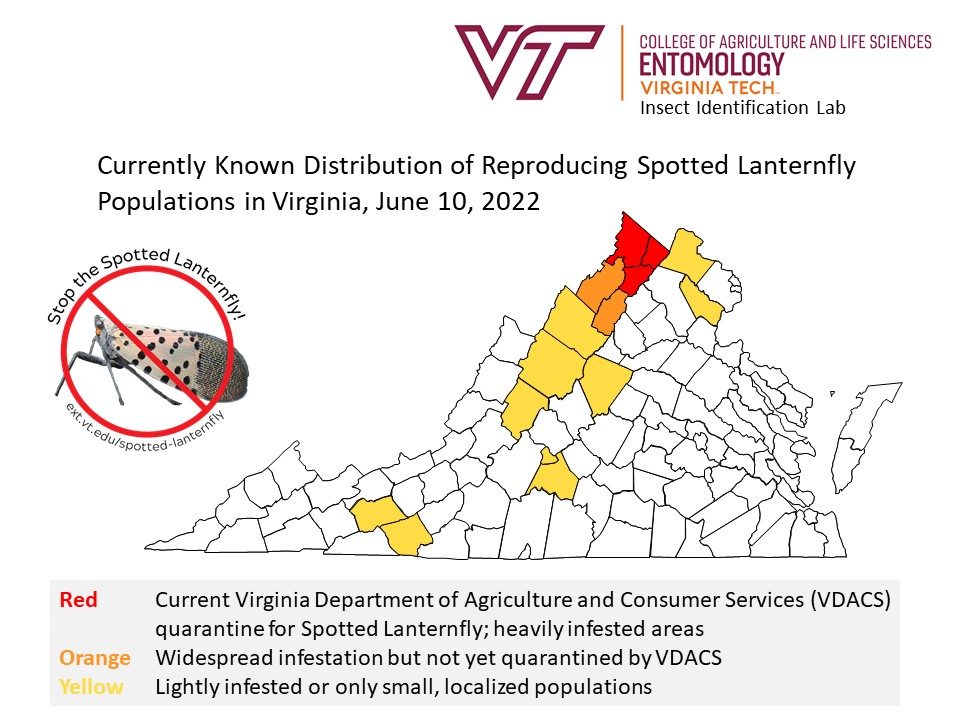
This map includes the most recent updates in geographic spread of SLF in Virginia, generated in the Insect Identification Lab in the Department of Entomology. Red counties are included in the VDACS quarantine; counties in orange have established populations but are not yet in quarantine.


The adult stage poses the greatest risk of immigration into vineyards, because of its mobility and attraction to grapevines. If adults are just showing up in an area, there is no need to overreact. In areas where SLF has been present in an area for a season or two, the pest pressure is likely to be higher. In the coming weeks, play close attention, looking for adults on cordons and canes. A provisional action threshold in vineyards is 5-10 adults per vine. I emphasize the term provisional. This may go up or down as we gain further experience with this insect in our vineyards. There is often a strong edge effect with this insect, and border sprays may be able to handle the problem, without spraying the whole block.

The Pest Management Guide chapters for Commercial Vineyards, Small Fruits and Hops can be found at this link (https://www.pubs.ext.vt.edu/456/456-017/456-017.html). There are several materials listed for this time of the season, when adults are the target. Once sprays start, reassess frequently. Pay close attention to the maximum applications or amounts applied per season, and watch preharvest intervals. I would very much like to hear more about this as it unfolds at your sites.

Here is a link to my SLF page (https://www.virginiafruit.ento.vt.edu/SLF.html). There is a table linked there listing SLF materials, with PHI and seasonal max levels. There are fact sheets post for SLF for general information, management in vineyards and in residential areas.

Let me know if you would like to discuss SLF at your location.
More later,
Doug

Tuesday, March 7, 2023

2023 Revisions to Fruit Pest Management Recommendations

Hello, everyone, We now have this year's updated pest management guides posted. The guides are available free online in PDF, and will also be available for purchase. 2023 Pest Management Guides
2023 Commercial Horticultural and Forest Crops (including Commercial Small Fruit, Commercial Vineyards, Commercial Hops)
2023 Home Grounds and Animals (including Home Fruit)
2023 Field Crops

2023 Spray Bulletin for Commercial Tree Fruit Growers.

Watch for more later!
Doug

Tuesday, February 14, 2023

2023 Orchard Fruit Schools

Hello, everone, This year's orchard fruit schools will be held the week of Feb 20-24. Details are provided below (Agendas are posted in the What's Hot in Apple section of the Virginia Fruit web site)

Mon, Feb 20, 8:30 AM - The Winchester Area Fruit School, Alson H. Smith AREC, Winchester.
Tues, Feb 21, 8:30 AM - The Madison-Rappahannock Fruit School, Graves Mt Lodge, Syria.
Wed, Feb 22, 8:30 AM - The Nelson-Albemarle (Central Virginia) Fruit School, Lovingston Fire Hall, Lovingston.
Thur, Feb 23, 8:30 AM - The Botetourt-Roanoke school, Brambleton Center, Roanoke.
Fri, Feb 24, 8:15 AM - Patrick-Carroll Fruit School, Lambsburg Community Center, Lambsburg.

Hope to see you at one of the schools!
Doug P.

Tuesday, February 7, 2023

Update on Spotted Lanternfly

Hello, everyone, It's time for an update on spotted lanternfly (SLF), as it continues its spread through the state. After the discovery of SLF in Winchester in 2018, a quarantine zone was erected - the insect was first found in Winchester and Frederick County, but as it spread, the quarantine zone included, in addition to those areas, Clarke and Warren Counties. In 2022, the zone was significantly expanded to include Albemarle, Augusta, Carroll, Nelson, Page, Prince William, Rockingham, Rockbridge, Shenandoah and Wythe Counties, plus the cities of Buena Vista, Charlottesville, Harrisonburg, Lexington, Lynchburg, Manassas, Manassas Park, Staunton and Waynesboro. The map of the quarantine zone is here:
The disjunct part of the range, in Wythe and Carroll Counties (near the North Carolina border), is almost certainly due to human-assisted transport. The site in Carroll County is near a parking lot at the junction of I-77 and Rt 58. A notable new find late this season was in the New River Valley, in the city of Radford (this does not yet show up in the quarantine zone - there is always a lag in the quarantine map because of administrative issues in expanding a quarantine zone). Dead adults were found at office windows across the street from private land with tree of heaven. The discovery was aided by spiders, whose webs on the window sills ensnared the adults!
At this time of year, SLF is in the egg stage. Eggs are laid not only on tree of heaven, but the bark of other trees, as well as inanimate objects. In vineyards with established populations, egg masses may be seen in high numbers on trellis posts. In one vineyard in northern Virginia, masses were seen in high numbers on treated wood end posts, shown here. Note how the presence of protective covering over the eggs deposited by the female varies from complete to absent.
One troubling observation was the concentration of egg masses in the inner (concave) surfaces of roll-formed steel trellis posts. This protective behavior will likely result in difficulties in achieving spray coverage with the development of effective ovicides. See the video here.


There will be further updates as this pest increases its presence in Virginia. More later, Doug P.

Thursday, July 28, 2022

Resources to Help in SLF Quarantine Compliance and Management

Hello, everyone,

Spotted lanternfly (SLF) is a potentially devastating pest of grape, now expanding its spread in Virginia. In July 2022, VDACS expanded a quarantine zone from 3 counties to 12, including contained independent cities.


Many vineyards and wineries will now need to deal with the quarantine protocol. At least one person per company will need to get certified through a short, on-line training session ($6.00). That person may train others in the company to assure compliance. All shipments and vehicles leaving the quarantine zone will need to be inspected. Information on the quarantine protocol may be found here (https://www.vdacs.virginia.gov/plant-industry-services-spotted-lanternfly.shtml). This site contains the protocol as well as the current version of the quarantine map.

The training required for certification is easy and inexpensive. Access to the training may be found here (https://register.ext.vt.edu/search/publicCourseSearchDetails.do;jsessionid=E3FEE1B1C1921BA6848B382063FC0BDE?method=load&courseId=1066947).

When doing inspections for quarantine compliance, it will be necessary to know what life stages of SLF can be expected. We have graph posted online that conveys this information clearly (https://www.pubs.ext.vt.edu/ENTO/Ento-268/ENTO-268.html). This can be posted where appropriate in your operation.

Theresa Dellinger and Eric Day in the Department of Entomology have created a useful aid for the public on the SLF quarantine, entitled "What Virginians Need to Know About SLF Quarantine expansion" (https://www.pubs.ext.vt.edu/ENTO/ENTO-319/ENTO-319.html).

Beyond matters of quarantine compliance, we have online resources for SLF management. There is a fact sheet on SLF management, available in English and Spanish, available here (https://www.pubs.ext.vt.edu/ENTO/ENTO-323/ENTO-323.html). In a similar fashion, a fact sheet for SLF management in residential areas (https://www.pubs.ext.vt.edu/ENTO/ENTO-322/ENTO-322.html).

Needless to say, SLF is covered in our annual chemical control recommendations for vineyards and home fruit. The risk to tree fruits is not considered to be as great; SLF will be included here as needed. It should be noted that orchardists will still need to deal with quarantine issues.

VCE Pest Management Guide for Commercial Vineyards (https://www.pubs.ext.vt.edu/content/pubs_ext_vt_edu/en/456/456-017/456-017.html)

VCE Pest Management Guide for Home Fruit (https://www.pubs.ext.vt.edu/456/456-018/456-018.htmls.html)

Last but not least, I maintain a spotted lanternfly page in the Virginia Fruit Site ( https://www.virginiafruit.ento.vt.edu/SLF.html). I intend for this to be one-stop shopping for matters on SLF, and all the above links are active there.

I hope this is useful. More later, Doug

Wednesday, July 6, 2022

Spotted lanternfly update: Large expansion of quarantine zone

Hello, everyone,

In May 2019, the Virginia Department of Agriculture and Consumer Services (VDACS) announced the establishment of a quarantine zone for spotted lanternfly (SLF). I posted on this here on 28 May of that year, and again on 3 June, when a public open house was announced to discuss compliance with the program. The quarantine zone initially contained Frederick, Clarke and Warren Counties plus the City of Winchester. A significant expansion of the zone is now planned, and will be formally announced in the next week or so. The quarantine zone additions will include the counties of Albemarle, Augusta, Carroll, Page, Prince William, Rockingham, Rockbridge, Shenandoah and Wythe, plus the cities of Buena Vista, Charlottesville, Harrisonburg, Lexington, Lynchburg, Manassas, Manassas Park, Staunton and Waynesboro. Here is the new zone map:


Here is a link to more information on the quarantine (https://www.vdacs.virginia.gov/pdf/spotted-lanternfly-quarantine.pdf). There will be public informational sessions to discuss the program, and facilitate compliance. One such meeting will be held on Aug 1, 5:50-8:30 PM, at King Family Vineyards. For more information, contact Grace Monger, gimonger@vt.edu (free with pre-registration, $10 at the gate). I will announce other sessions as I learn of dates.

One of the conditions of the quarantine is that at least one person within each company (vineyard, winery, orchard, hops yard, etc.) be certified to inspect and approve vehicles or shipments leaving the quarantine zone. The current certification program is linked here. Cost for a certification is $6.00.

The quarantine zone is being expanded because SLF continues to spread in Virginia. Different maps are prepared reflecting this spread. There are understandable differences in details among maps depending on the nature of programs - approvals that are needed for a quarantine, official identification of SLF samples, etc. Here are two current maps. The first has been developed within the Department of Entomology at Virginia Tech, by Eric Day and Theresa Dellinger. The second is maintained in a SLF site by the New York State IPM program at Cornell University.

These two maps reflect two infested counties not yet included in the quarantine: Campbell and Loudoun. An important point of the Cornell map is that it includes the whole range of SLF. A significant point here is that SLF has turned up in North Carolina, the first infestation for this state, in Forsythe County, Close to I-44. More information on the NC infestation can be seen here.

Summary: Important take-away points here are that SLF has continued its spread, now including the whole Shenandoah Valley, further incursions in the Piedmont of Virginia, and a significant jump into southern Virginia, almost certainly assisted by human transportation, at the junction of two major highways. There has been an expansion into North Carolina, close to (though not adjacent) to Carroll and Wythe Counties. VDACS is set to announce a significant expansion of the SLF quarantine zone in Virginia. Watch for annoucements of informational meetings in affected counties.

You can contact me for information on spotted lanternfly biology or management. For questions on the quarantine program itself, contact VDACS at spottedlanternfly@vdacs.virginia.gov, or 804-786-3515.

More later, Doug

Grape Root Borer Mating Disruption for 2026

Hello, everyone, We have received word that our application for a Section 18 label for Isomate GRB Z has been approved. This is a mating ...

Indicia statement

Virginia Cooperative Extension programs and employment are open to all, regardless of age, color, disability, gender, gender identity, gender expression, national origin, political affiliation, race, religion, sexual orientation, genetic information, veteran status, or any other basis protected by law. An equal opportunity/affirmative action employer. Issued in furtherance of Cooperative Extension work, Virginia Polytechnic Institute and State University, Virginia State University, and the U.S. Department of Agriculture cooperating. Edwin J. Jones, Director, Virginia Cooperative Extension, Virginia Tech, Blacksburg; M. Ray McKinnie, Administrator, 1890 Extension Program, Virginia State University, Petersburg.